Every month, somewhere in the food industry, a reformulation goes wrong in a way that nobody expected.
The R&D team did their homework. The brief was clear. The sweetener was sourced. The trials began. And then the product did not taste right. The sweetness was either too weak or overwhelming. The flavour profile had notes that nobody could quite explain. The formulation that looked correct on paper produced something that did not work in the mouth.
The team blames the formula. They adjust ratios. They run more trials. They spend weeks going in circles.
In many of these cases more than most procurement teams would be comfortable admitting the problem is not the formula at all.
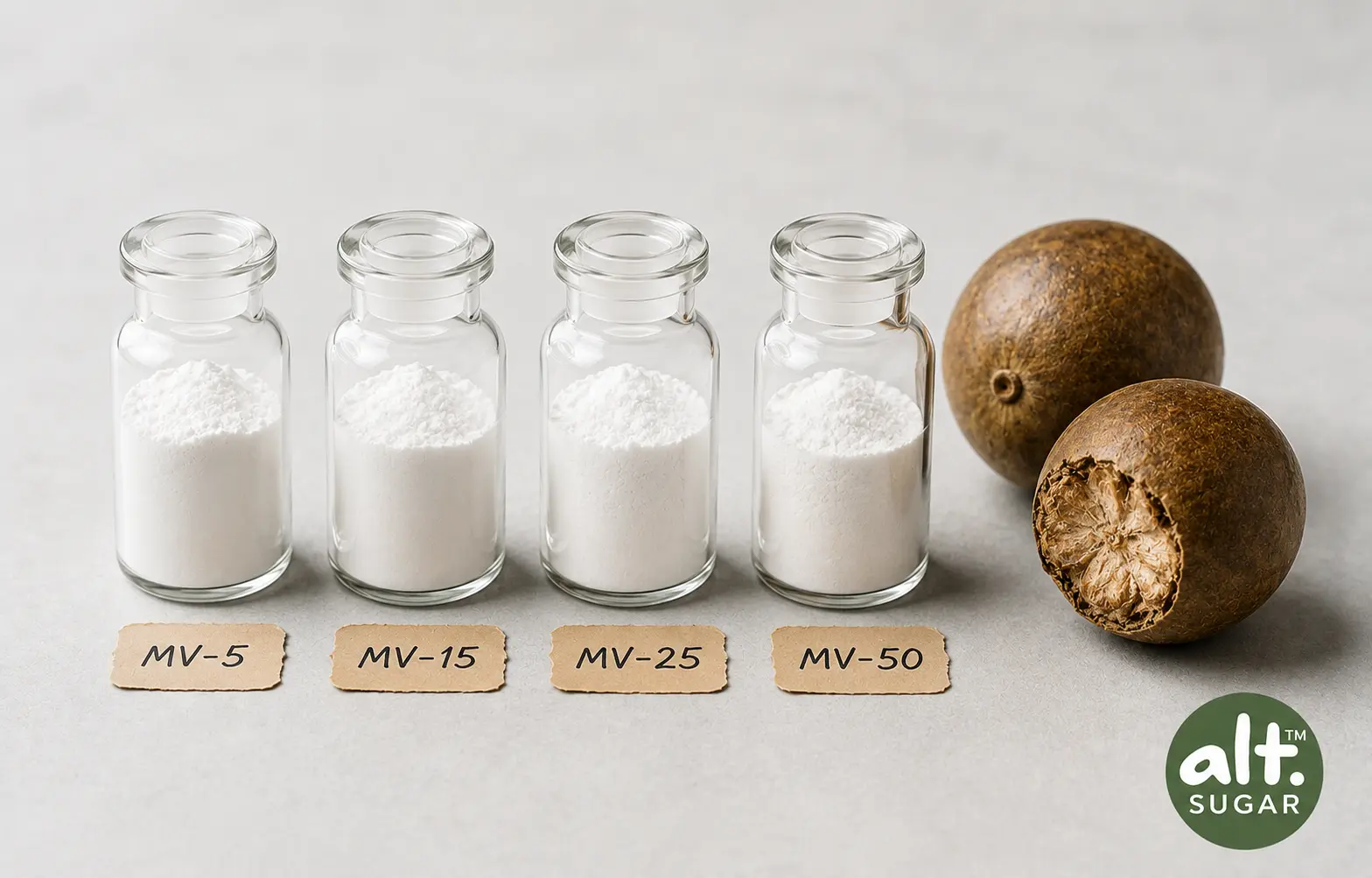
The problem is that the Monk Fruit Extract they are using is not what they thought they were buying.
The Misunderstanding That Costs Brands Time and Money
Here is the fundamental issue with Monk Fruit Extract as a commercial ingredient.
The name Monk Fruit Extract describes a category, not a specific ingredient. Within that category exists an enormous range of products from a relatively mild sweetening powder with modest intensity to a highly concentrated, premium-grade extract that delivers sweetness at 200 times the intensity of sugar.
Both are called Monk Fruit Extract. Both will arrive in a white powder. Both will carry broadly similar certifications. And both will be priced very differently for reasons that the label does not always make clear to a buyer who does not know what to look for.
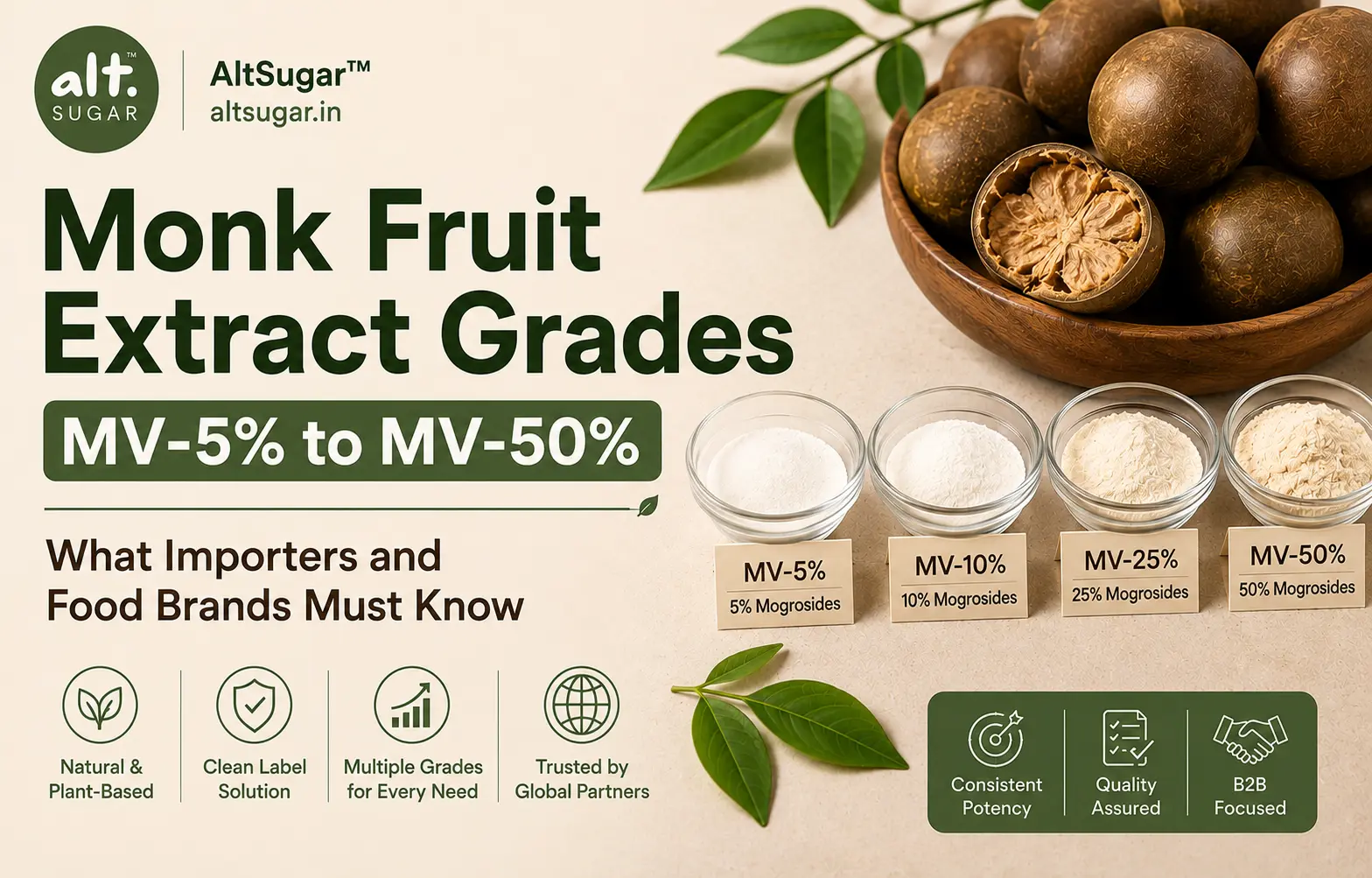
The differentiating factor is the concentration of a compound called Mogroside-V written as MV, followed by a percentage. That percentage is the single most important number in any Monk Fruit sourcing conversation. And it is the number that a surprising number of buyers either do not ask about, or do not fully understand when they do.
I want to fix that today.
What Mogroside-V Actually Is
Monk Fruit known in China as Luo Han Guo, cultivated in the mountainous regions of Guangxi province for centuries gets its sweetness from a family of compounds called Mogrosides. Several Mogroside compounds exist in the fruit, but Mogroside-V is the one that matters most commercially. It is the primary sweetness contributor, the most potent, and the most valuable.
When a supplier quotes you an MV percentage, they are telling you what proportion of the extract is pure Mogroside-V. The higher the percentage, the more concentrated the sweetness, the smaller the usage level required, and consequently the higher the cost per kilogram.
This relationship between MV percentage, sweetness intensity, and usage level is the foundation of every intelligent Monk Fruit sourcing decision. Understanding it properly means you can evaluate a supplier's price not just on cost per kilogram but on cost per unit of sweetness delivered which is the number that actually matters for your formulation economics.
The Four Grades What They Mean and Where They Work
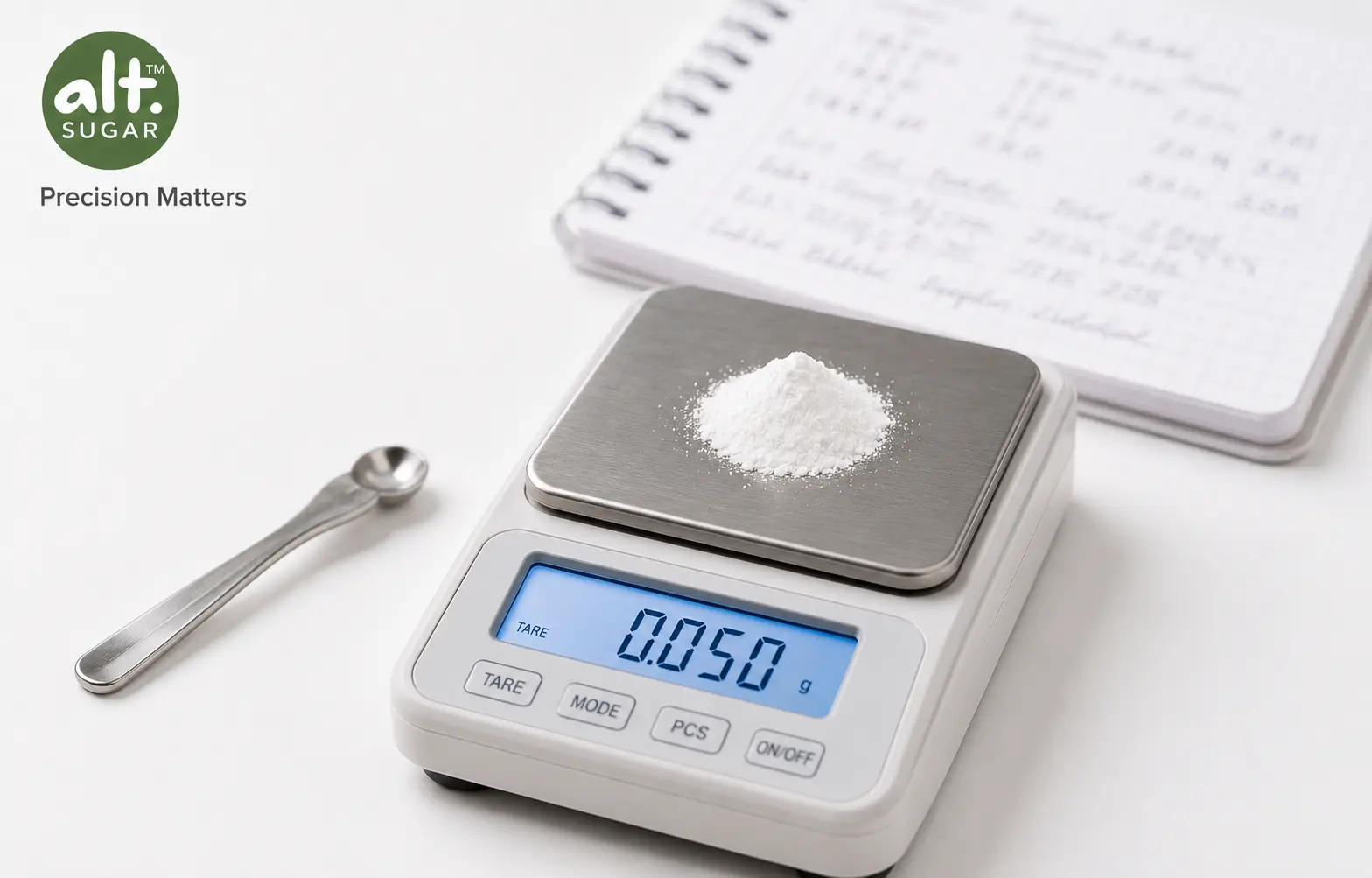
MV-5% The Entry-Level Grade
At MV-5%, the Mogroside-V concentration is relatively low. The extract delivers approximately 20 times the sweetness of sugar. It is the most economical grade and for certain applications, it is entirely appropriate.
Where it works best: blended sweetener systems where Monk Fruit is one component of a broader formulation alongside erythritol, stevia, or date-based ingredients. Mass-market beverage applications where cost management is a primary constraint. Sauces and condiments where the sweetness intensity requirements are moderate.
Where it does not work: applications requiring strong sweetness reduction at low usage levels. Premium positioning where the label value of Monk Fruit needs to be backed by genuine functional performance. Any formulation where bitterness or off-notes need to be minimised MV-5% has more non-Mogroside compounds that can contribute to flavour complexity, not always in desirable ways.
MV-15% The Balanced Grade
MV-15% delivers approximately 60 times the sweetness of sugar. The taste profile is noticeably cleaner than MV-5%. The cost is higher, but the usage level is proportionally lower, which means the cost-in-use calculation is more favourable than the raw price suggests.
Where it works best: soft drinks and flavoured waters where a clean sweet profile is needed without strong aftertaste. Nutrition bars and functional snacks reformulating to reduce refined sugar. Blended formulations where Monk Fruit is paired with Stevia Reb-M for cost optimisation. Dairy applications including flavoured milks and yogurts.
Where it does not work: ultra-low sugar applications where maximum sweetness intensity at minimum usage level is the priority. Products where very high purity is a regulatory or positioning requirement.
MV-25% The Premium Mid-Grade
MV-25% delivers approximately 100 times the sweetness of sugar. At this grade, the taste profile becomes noticeably smoother. Aftertaste is reduced. Mouthfeel improves. This is the grade where Monk Fruit begins to behave like the premium natural sweetener it is positioned as.
Where it works best: protein powders and nutritional supplements where taste quality is a brand differentiator. Functional confectionery where a clean, premium sweet experience is expected. Applications positioned in the better-for-you premium segment where the ingredient story supports the price point. Beverage brands that have made Monk Fruit part of their front-of-pack communication.
Where it does not work: price-sensitive mass-market reformulations where MV-15% achieves the brief at lower cost.
MV-50% The High-Intensity Premium Grade
MV-50% is the highest standard grade commercially available. It delivers approximately 200 times the sweetness of sugar. The taste profile at this level is the cleanest available minimal off-notes, smooth onset, no lingering bitterness. This is the grade that has driven Monk Fruit's growing reputation as the most taste-acceptable natural high-intensity sweetener on the market.
Where it works best: premium beverage brands where taste is the primary differentiator and formulation cost is secondary to sensory quality. Pharmaceutical and nutraceutical applications where purity specifications are stringent. Baby foods and infant nutrition where ingredient quality is non-negotiable and parents read every specification. High-value confectionery and premium bakery where the Monk Fruit claim supports a significant price premium.
Where the economics work: at MV-50%, usage levels are so low that despite the higher per-kilogram cost, the cost-in-use for many applications is comparable or even lower than MV-15% or MV-25%. This is the calculation that surprises most procurement teams when they run it for the first time.
The Five Questions Every Importer Must Ask Before Placing an Order
After six years of working with food manufacturers and procurement functions on natural sweetener sourcing, I have watched the same mistakes appear with frustrating regularity. These five questions eliminate the most common and most expensive ones.
Question One: What is the exact MV percentage, and is it third-party verified?
Do not accept high purity or premium grade as an answer. Ask for the specific MV percentage and ask for the third-party lab certification that confirms it. A reputable supplier will have this documentation ready. A supplier who cannot produce it is telling you something important about their quality systems whether they intend to or not.
Question Two: What certifications does this product carry?
For serious food manufacturing and particularly for export markets, the minimum certification set should include Non-GMO, Kosher, Halal, and relevant food safety certifications ISO, HACCP, or FSSC 22000, depending on your market requirements. Some markets have specific regulatory approvals for Monk Fruit Extract that are separate from general food safety certification. Know your target market's requirements before you source.
Question Three: How does this grade perform in my specific application?
This is the question that separates ingredient partners from ingredient vendors. A supplier who can answer this question specifically based on actual formulation experience with your application type is worth considerably more than one who can only answer questions about their product in isolation.
Monk Fruit behaves differently in a carbonated beverage, a baked good, a dairy product, and a confectionery application. The grade that works beautifully in one may underperform in another. Application-specific guidance is not a nice-to-have. It is the difference between a successful reformulation and a costly restart.
Question Four: What is the supply chain reliability and minimum order commitment?
Monk Fruit is sourced from a relatively concentrated geographic area. Harvest yields vary by season. Premium grades particularly MV-50% have limited global supply compared to demand. Understanding your supplier's sourcing reliability, their inventory position, and their ability to guarantee consistent quality across multiple shipments is a sourcing risk question as much as a quality question.
Reformulating a product and then facing supply interruption mid-launch is a scenario worth spending time to avoid.
Question Five: What is the cost-in-use, not just the cost per kilogram?
At what usage level does this grade achieve the sweetness equivalent of X grams of sugar in my application? What does that translate to in cost per unit of finished product? The answer to this question almost always changes the procurement conversation and often makes higher MV grades look considerably more attractive than the raw price per kilogram suggested.
Why Blending Changes the Economics
One of the most important developments in natural sweetener formulation in recent years is the growing understanding that Monk Fruit Extract performs best as part of a sweetening system rather than as a standalone replacement for refined sugar.
The reason is structural. Refined sugar does multiple jobs in a food formulation sweetness, of course, but also bulk, mouthfeel, texture, moisture retention, and browning in baked goods. Monk Fruit Extract, as a high-intensity sweetener used at very low levels, delivers the sweetness but not the other functional properties.
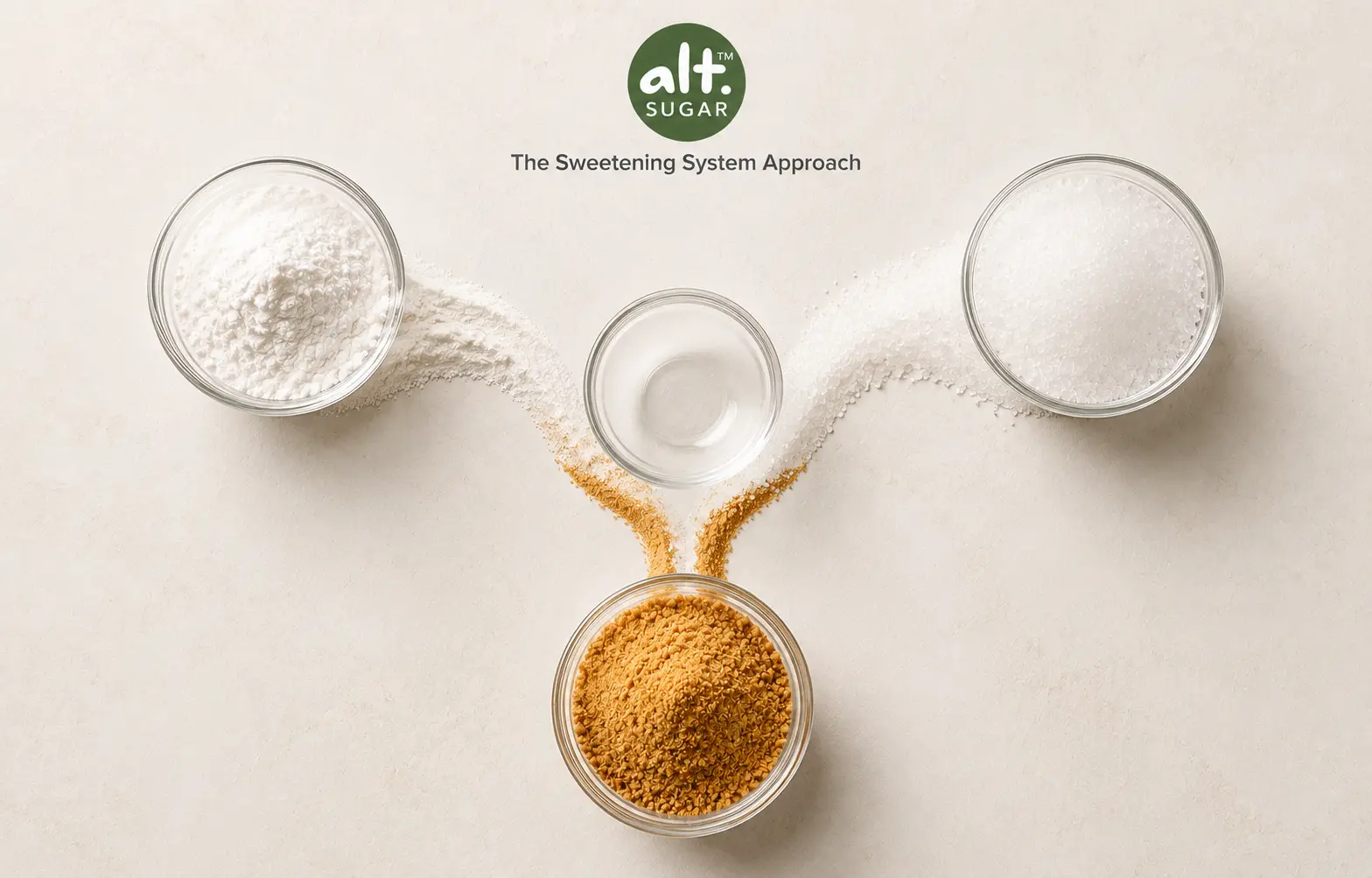
The solution is a blend. Monk Fruit with erythritol provides sweetness intensity plus bulk and a more sugar-like sensory experience. Monk Fruit with Stevia Reb-M creates a complementary sweetness profile that is cleaner than either ingredient alone. Monk Fruit with Date Powder delivers sweetness alongside genuine nutritional value, fiber, and a natural caramel complexity that high-intensity sweeteners alone cannot provide.
At AltSugar™ we work with food brands on exactly these blend formulations combining Monk Fruit Extract with other natural sweeteners from our portfolio to create systems that solve the full formulation brief rather than just the sweetness component of it.
The blend is usually where the real breakthrough happens. And it is almost always more cost-effective than trying to solve every formulation challenge with a single ingredient.
What We Have Observed Working With Procurement Teams
I want to share something honest from the conversations I have had with procurement heads and R&D directors over the years.
The Monk Fruit sourcing conversation almost always starts in the same place: price per kilogram. That is a reasonable starting point. Procurement functions are responsible for cost management, and Monk Fruit Extract is not an inexpensive ingredient.
But the conversation almost always needs to move to a different place before a good decision can be made: cost per unit of sweetness delivered, application performance, supply reliability, and the total cost of a failed reformulation versus a successful one.
A reformulation that uses the wrong Monk Fruit grade, produces a product that tastes wrong, and requires three additional months of R&D and a relaunch that is not a cheap sourcing decision, even if the ingredient cost per kilogram was the lowest available.
The brands that get Monk Fruit right are the ones that start the conversation with performance requirements rather than price requirements. Price becomes the negotiation once performance is confirmed. Starting with price and hoping performance follows is where the expensive mistakes are made.
AltSugar™ supplies Monk Fruit Extract in MV-5%, MV-15%, MV-25%, and MV-50% grades. We work with your R&D team to identify the right grade for your specific application before a sourcing commitment is made. We provide sample quantities for formulation trials. And we supply in bulk volumes with the consistency and documentation that global food manufacturing requires.
The Takeaway
Monk Fruit Extract is one of the most exciting natural sweeteners available to the food industry today. Its combination of clean-label credentials, zero-calorie profile, genuine heat stability, and at the right grade exceptional taste quality makes it a powerful tool for any brand serious about sugar reduction.
But it is only a powerful tool when it is the right grade, sourced from a supplier with the quality systems to back the specification, and formulated correctly for the application it is intended for.
The brands that get this right that invest the time to understand grade selection, build a supply relationship based on performance rather than price alone, and treat the sweetening system rather than the sweetener as the solution are the ones that end up with products they are proud of and consumers who notice the difference.
The brands that treat Monk Fruit as a commodity purchase, choose by price per kilogram, and skip the application testing step are the ones who end up back at the beginning, wondering why their reformulation did not work.
The difference between those two outcomes is almost entirely a function of how the sourcing conversation was started.
Start it with the right questions. The answers will follow.
Share this article

About the Author
Sachhin Kummar
Founder, AltSugar™
Sachhin Kummar is the Founder of AltSugar™, an ingredient company dedicated to helping food manufacturers, FMCG brands, and food innovators reduce refined and synthetic sugar through natural, clean-label sweetening solutions. With 6+ years working specifically with R&D teams, procurement functions, and product development leaders on the natural sweetener transition.
Connect on LinkedIn