I want to start with a question.
Think about the last packaged food product you bought a breakfast cereal, a flavoured yogurt, a protein bar, a fruit juice, a sauce, a biscuit. Now ask yourself honestly: did it contain sugar?
If your answer is no or I am not sure there is a very good chance you are wrong.
Not because you were careless. Not because you failed to read the label. But because the food industry has spent decades developing a vocabulary specifically designed to make sugar difficult to find even when you are looking for it.
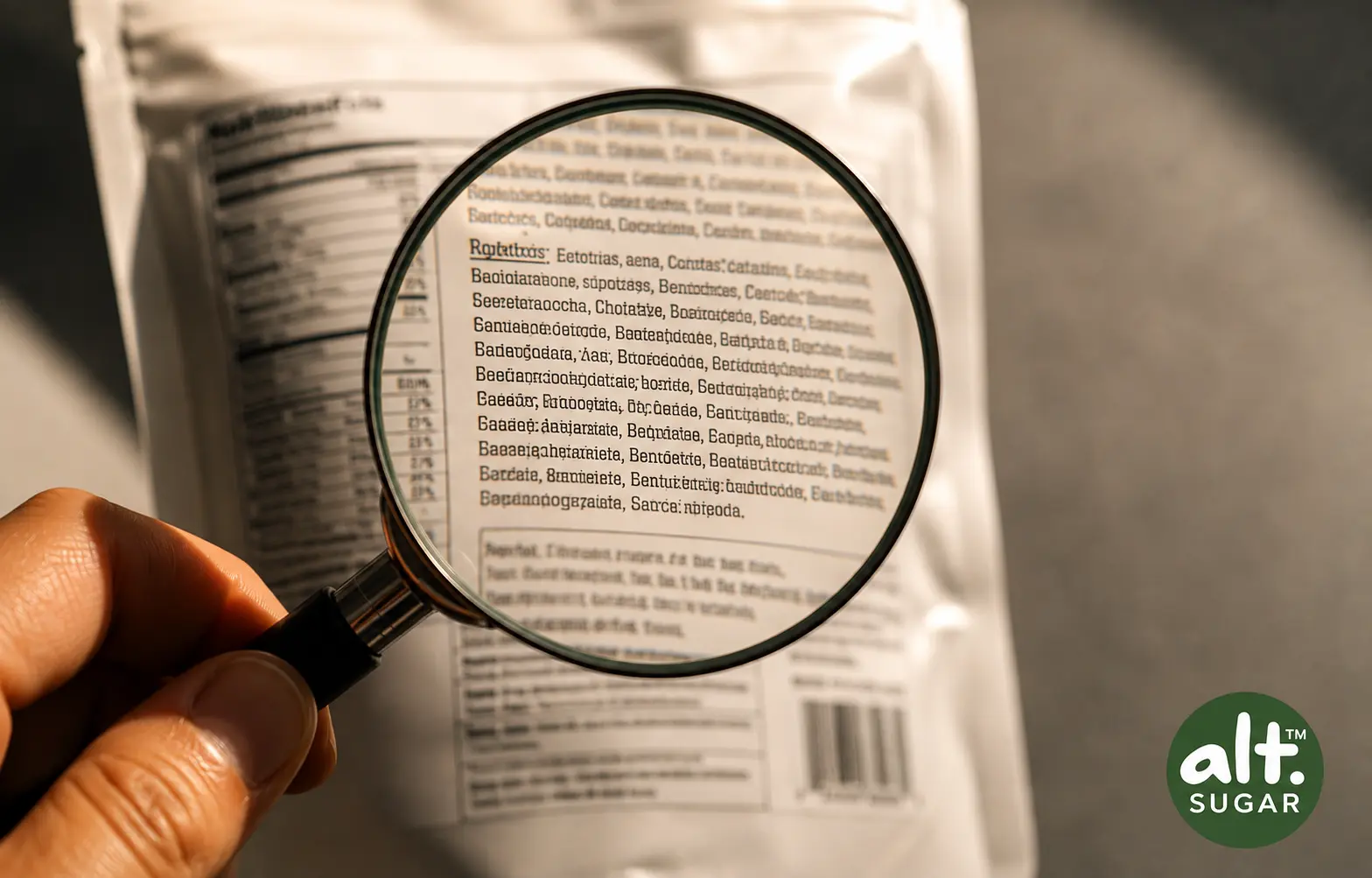
I have spent over six years working with food manufacturers, R&D teams, and procurement functions across India and internationally. I have sat in product development meetings where the brief was to reduce sugar while keeping the sweetness. I have watched formulations where sugar was genuinely replaced with something better. And I have also seen the other approach the one where sugar simply gets a different name, and the label quietly moves on.
This blog is about the second approach. And why it matters more than most people realise.
Why Sugar Needs 56 Names
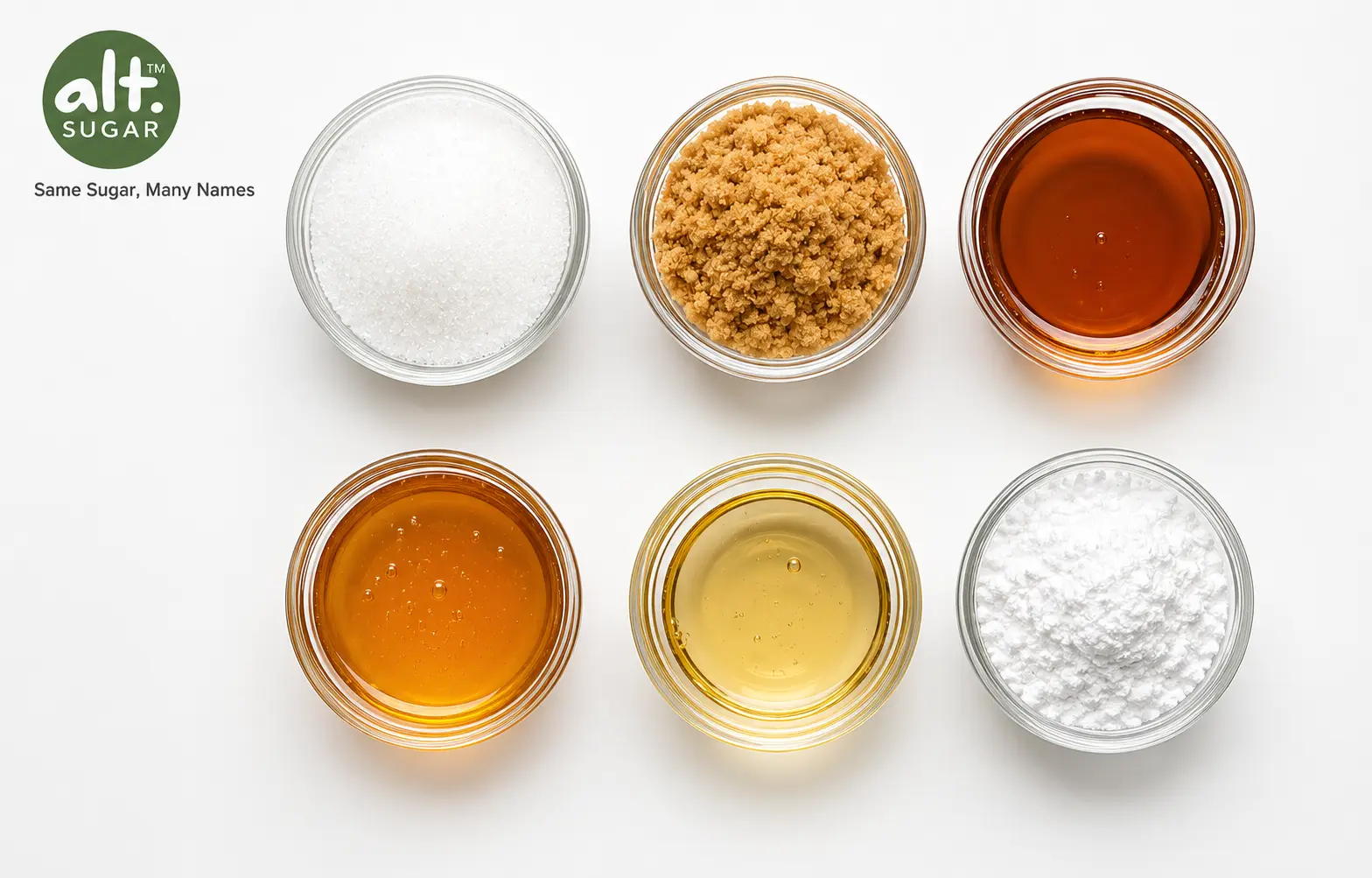
Refined sugar is not one molecule with one name. It is a category of sweetening ingredients various forms of glucose, fructose, sucrose, maltose, and their derivatives that the food industry sources from multiple raw materials and uses across thousands of applications.
Some of those names are genuinely different ingredients with meaningfully different properties. Fructose behaves differently from glucose. Maltose has different applications from sucrose. The chemistry is real.
But here is what is also real: the proliferation of names on food labels has created a situation where a consumer actively trying to reduce their sugar intake can read an ingredient list, see no mention of sugar, and walk away with a product that is, by any practical measure, a sugar product.
That is not an accident. It is the predictable result of an industry that for decades has treated the consumer's desire for less sugar as a marketing challenge rather than a formulation challenge.
The marketing challenge has been solved brilliantly. The formulation challenge the one that actually requires replacing sugar with something genuinely better is the harder work. It is the work that AltSugar™ exists to support.
But before we talk about solutions, let us be completely clear about the problem.
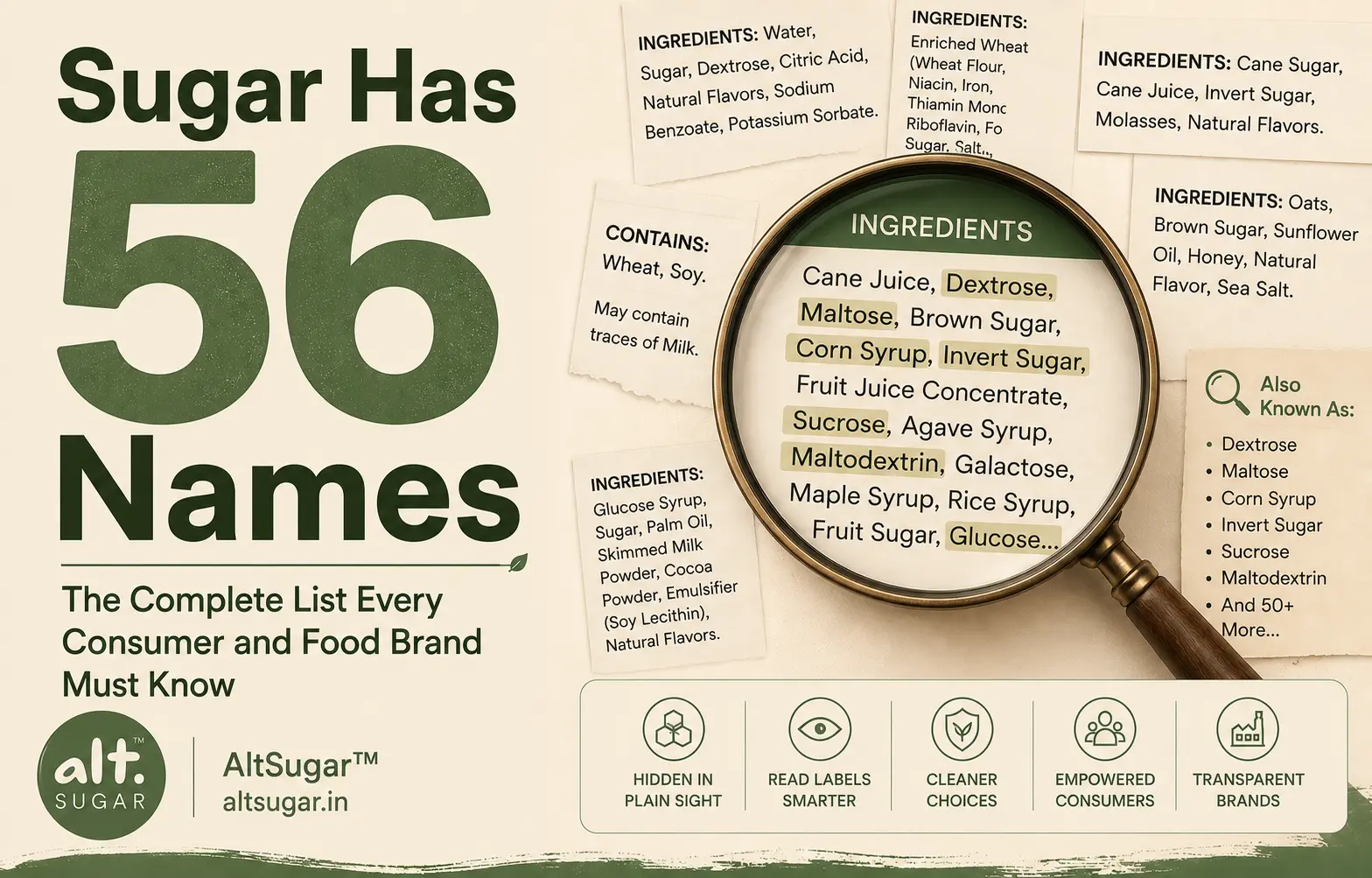
The Complete List 56 Names Sugar Hides Under
The next time you pick up a packaged food product, these are the names to look for. Every single one of them is, in practical terms, added sugar:
The Sugar Family
Sugar, Cane Sugar, Raw Sugar, Brown Sugar, White Sugar, Powdered Sugar, Confectioners Sugar, Beet Sugar, Invert Sugar, Invert Sugar Syrup, Raw Cane Sugar, Turbinado Sugar, Muscovado Sugar, Demerara Sugar, Caster Sugar
The Syrup Family
Corn Syrup, High-Fructose Corn Syrup (HFCS), Golden Syrup, Malt Syrup, Rice Syrup, Brown Rice Syrup, Oat Syrup, Tapioca Syrup, Glucose Syrup, Refiners Syrup, Sorghum Syrup, Cane Juice Syrup
The -ose Family
Glucose, Fructose, Sucrose, Dextrose, Maltose, Lactose, Galactose, Trehalose
The Juice and Concentrate Family
Fruit Juice Concentrate, Apple Juice Concentrate, Grape Juice Concentrate, Evaporated Cane Juice, Fruit Juice, Cane Juice
The Natural Sounding Family
Honey, Agave, Agave Nectar, Agave Syrup, Maple Syrup, Molasses, Blackstrap Molasses, Carob Syrup, Date Syrup (when used as added sugar without being declared as such)
The Technical Family
Dextrin, Maltodextrin, Barley Malt, Barley Malt Extract, Malt Extract, Ethyl Maltol, Caramel, Caramel Syrup
Read that list again slowly. Fifty-six names. Appearing across breakfast cereals, baby foods, protein bars, sauces, yogurts, breads, juices, sports drinks, and thousands of other products that millions of people consume every day often while believing they are making a healthy choice.
The Three Tricks That Make Hidden Sugar So Effective
Understanding the list is important. Understanding how it gets deployed is equally important.
Trick One: Ingredient Splitting
Ingredient lists are displayed in descending order of quantity. If a product contains 30 grams of added sugar, listing it as a single ingredient would place it near or at the top of the list which is commercially undesirable.
The solution is to split the sugar across multiple forms. Use some cane sugar, some corn syrup, some dextrose, some maltodextrin. Each individual ingredient appears lower on the list. The total sugar content remains the same. The label looks cleaner.
This is a legal practice. It is widely used. And it is precisely the kind of formulation decision that the growing clean-label movement is, slowly but decisively, making commercially less attractive.
Trick Two: The Health Halo
Certain sugar names carry a perceived health benefit that the product's marketing team leverages sweetened with honey, contains agave nectar, made with fruit juice concentrate.
Honey is sugar. Agave is approximately 85% fructose a higher fructose concentration than high-fructose corn syrup. Fruit juice concentrate is fruit with the water and most of the fiber removed, leaving concentrated sugar.
The health halo is real in perception. In nutritional terms, for most consumers and most applications, it is not meaningfully different from the refined sugar it replaced.
Trick Three: The Small Print
Nutrition information panels display Total Sugars and increasingly Added Sugars but many consumers do not know how to use that information effectively.
A product with 18 grams of sugar per 100 grams is nearly one fifth sugar by weight. Presented in a 25-gram serving, that becomes 4.5 grams a number that sounds manageable until you realise most people consume considerably more than the stated serving size.
How to Read a Label in Under Two Minutes
I want to give you something practical here. A simple method that works regardless of which name the sugar is hiding under.
Step One
Go straight to the nutrition panel, not the ingredient list. Find Total Sugars per 100 grams. This is the most honest number on the label. It captures everything natural sugars and added sugars combined.
Step Two
Apply the simple benchmark. Under 5 grams of total sugar per 100 grams: low sugar. 5 to 15 grams: moderate. Over 15 grams: high sugar. Over 22.5 grams: very high. A product marketed as a healthy choice should comfortably sit in the low category.
Step Three
Check the ingredient list for the 56 names. Count how many appear. One or two may be incidental. Three or more particularly if they appear in the first five ingredients is a signal that sugar is doing significant structural work in this product, regardless of what the front of pack says.
Step Four
Ask one question. If the ingredient list were just the first three items, would you still buy this product? The first three ingredients make up the majority of what you are consuming. Everything else is detail.
That is it. Four steps. Under two minutes. And you will never read a food label the same way again.
What a Clean-Label Sweetener Actually Looks Like
Now that we understand what we are trying to move away from, what does the alternative look like in practice?
A genuinely clean-label sweetener has three characteristics.
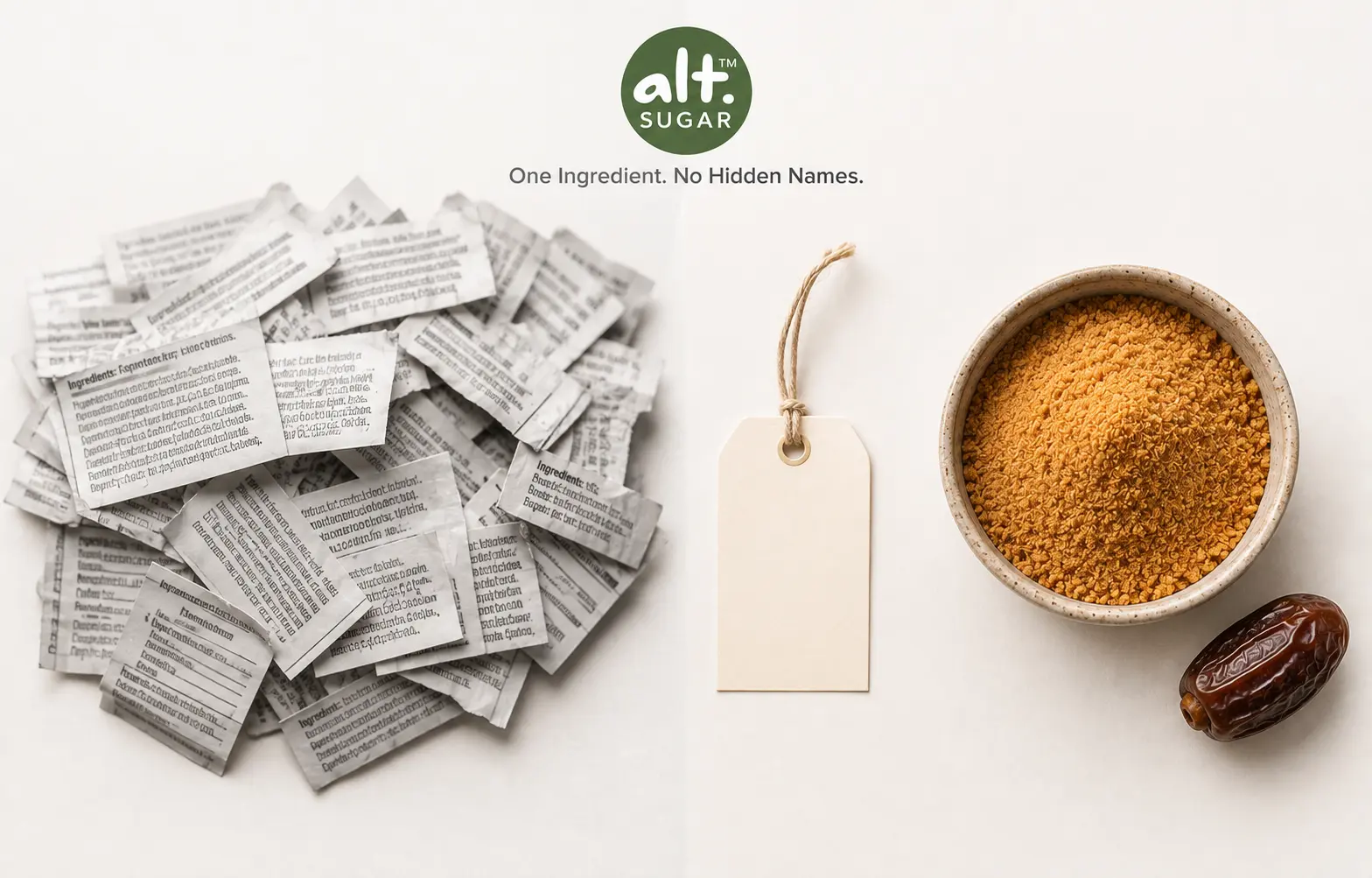
One: The ingredient list is short and readable
Date Sugar is one ingredient: dates. Coconut Sugar is one ingredient: coconut palm nectar. Monk Fruit Extract is one ingredient: monk fruit. A consumer reading these names does not need a chemistry degree. They know what these things are.
That transparency is not just ethically right it is commercially powerful in a market where trust has become a purchasing criterion.
Two: The nutritional trade-off is honest
Date Sugar is not calorie-free. Coconut Sugar is not a superfood. These are not miracle ingredients. What they are is genuinely different from refined sugar in ways that matter lower glycemic response, retained minerals and fiber, a flavour complexity that comes from the whole food source rather than from flavour additives.
The claim is honest because the ingredient is honest.
Three: The supply chain is traceable
When AltSugar™ supplies Date Powder to a food brand, that ingredient comes from date farms in Rajasthan and Gujarat. The farmer who grew the dates is the beginning of a supply chain that ends on a food label and every step of that chain can be described simply and truthfully.
That traceability is increasingly what retailers, regulators, and consumers are demanding. It is also simply the right way to build a food ingredient business.
A Note For Food Brands Reading This
If you manufacture food products and you have read this far I want to address you directly.
I am not writing this to create discomfort. I am writing it because the direction of travel is clear, and the brands that get ahead of it now will be in a far stronger position than those that wait.
Consumer health literacy is not going backwards. Label scrutiny is not going to decrease. The regulatory environment around added sugar is tightening in every major market. And the generation of consumers entering peak purchasing power right now people in their late twenties and thirties who grew up with smartphone access to nutritional information are the most label-aware consumer cohort the food industry has ever faced.
The question is not whether to reformulate. The question is when, and with what.
AltSugar™ works with food manufacturers, FMCG brands, R&D teams, and procurement functions on exactly this transition from the initial formulation conversation through to bulk supply of finished, certified, export-ready natural sweetening ingredients. We have done this across bakery, confectionery, beverages, baby food, nutraceuticals, HoReCa, and white-label manufacturing.
The conversation is easier to start than most brands expect. And the reformulation is almost always better than the team that undertook it anticipated.
The One-Sentence Rule
I want to leave you with something simple enough to use immediately whether you are a consumer reading labels in a supermarket, or a product developer reviewing a formulation brief.
If you cannot explain every ingredient on the label to a ten-year-old in one sentence, ask why it is there.
Sugar has 56 names because simplicity was not the objective.
The food industry is capable of doing better. The ingredients exist. The supply chains exist. The formulation knowledge exists. The only thing required now is the decision to use them.
Share this article

About the Author
Sachhin Kummar
Founder, AltSugar™
Sachhin Kummar is the Founder of AltSugar™, an ingredient company dedicated to helping food manufacturers, FMCG brands, and food innovators reduce refined and synthetic sugar through natural, clean-label sweetening solutions. With 6+ years working specifically with R&D teams, procurement functions, and product development leaders on the natural sweetener transition.
Connect on LinkedIn