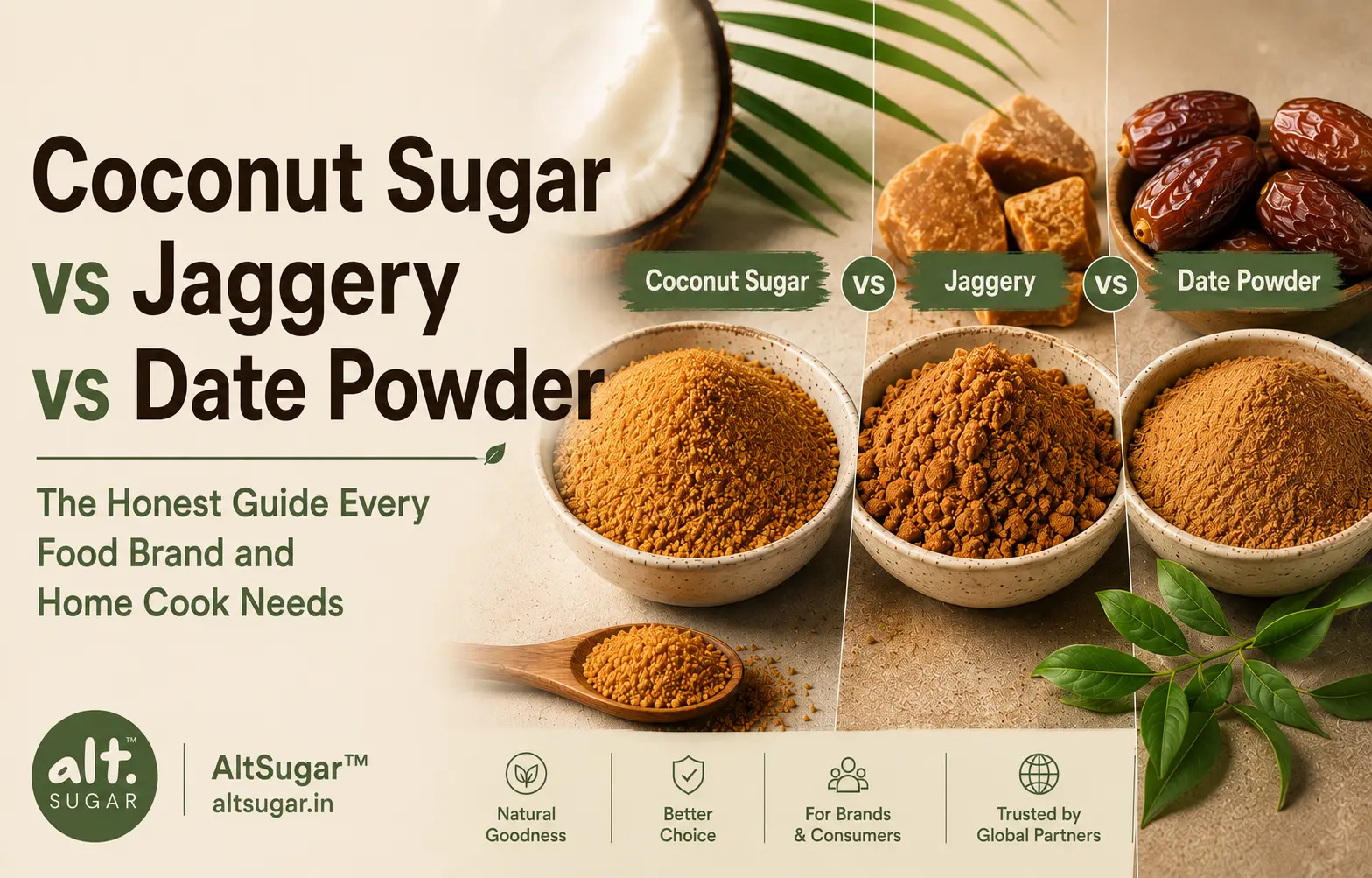
I grew up eating all three.
In Rajasthan, jaggery was in the kitchen before anything else. Dense, dark, earthy the sweetener that had been in Indian homes for generations before refined sugar arrived and tried to replace it. In Kerala and coastal Karnataka, coconut was everywhere in cooking, in oil, in water, and yes, in sweeteners. In the date-growing belt of Gujarat and Rajasthan, where I have spent a significant part of the last six years visiting farms and understanding supply chains, the date itself and what you can make from it is a revelation most of the world has not yet had.
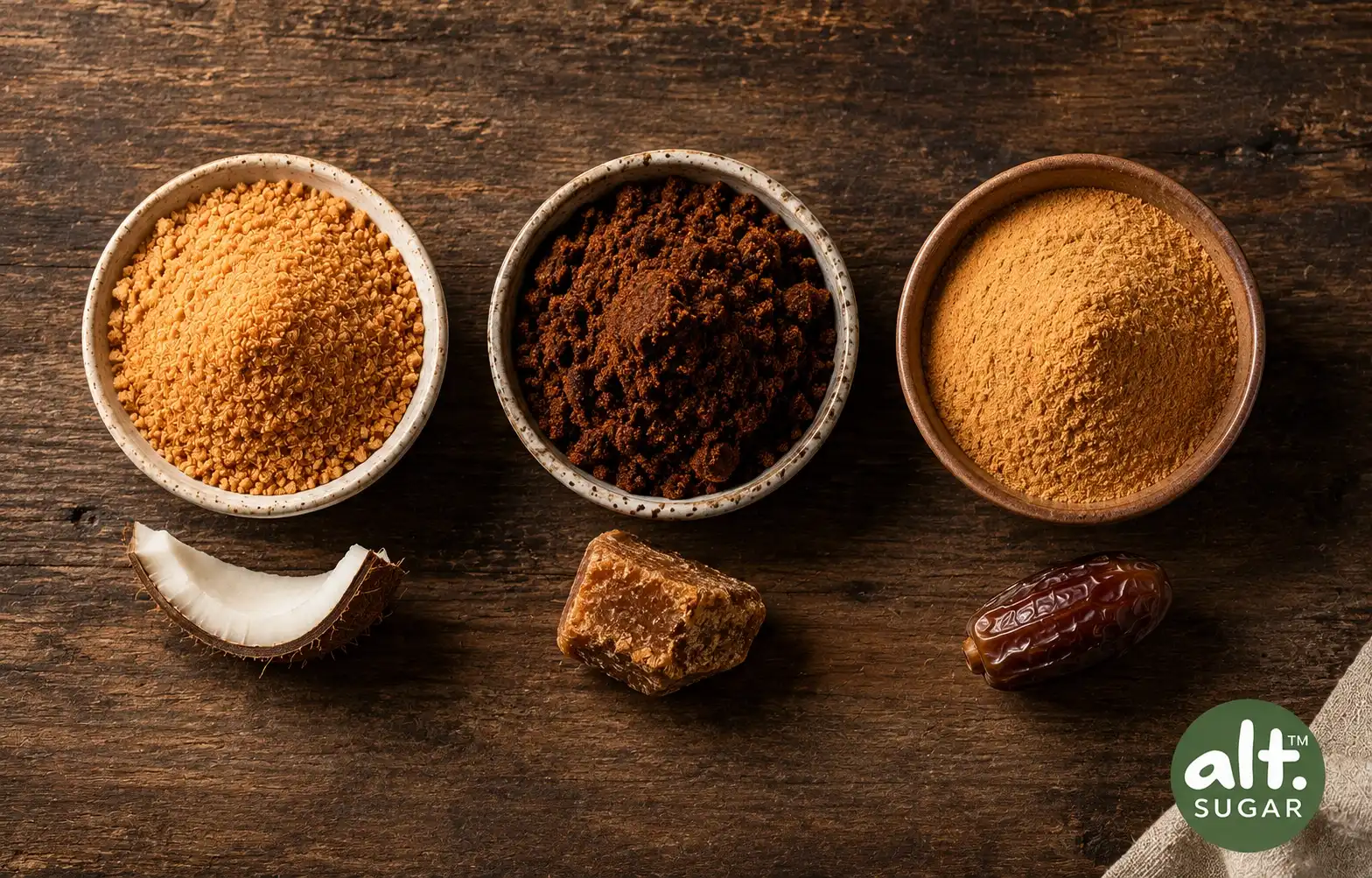
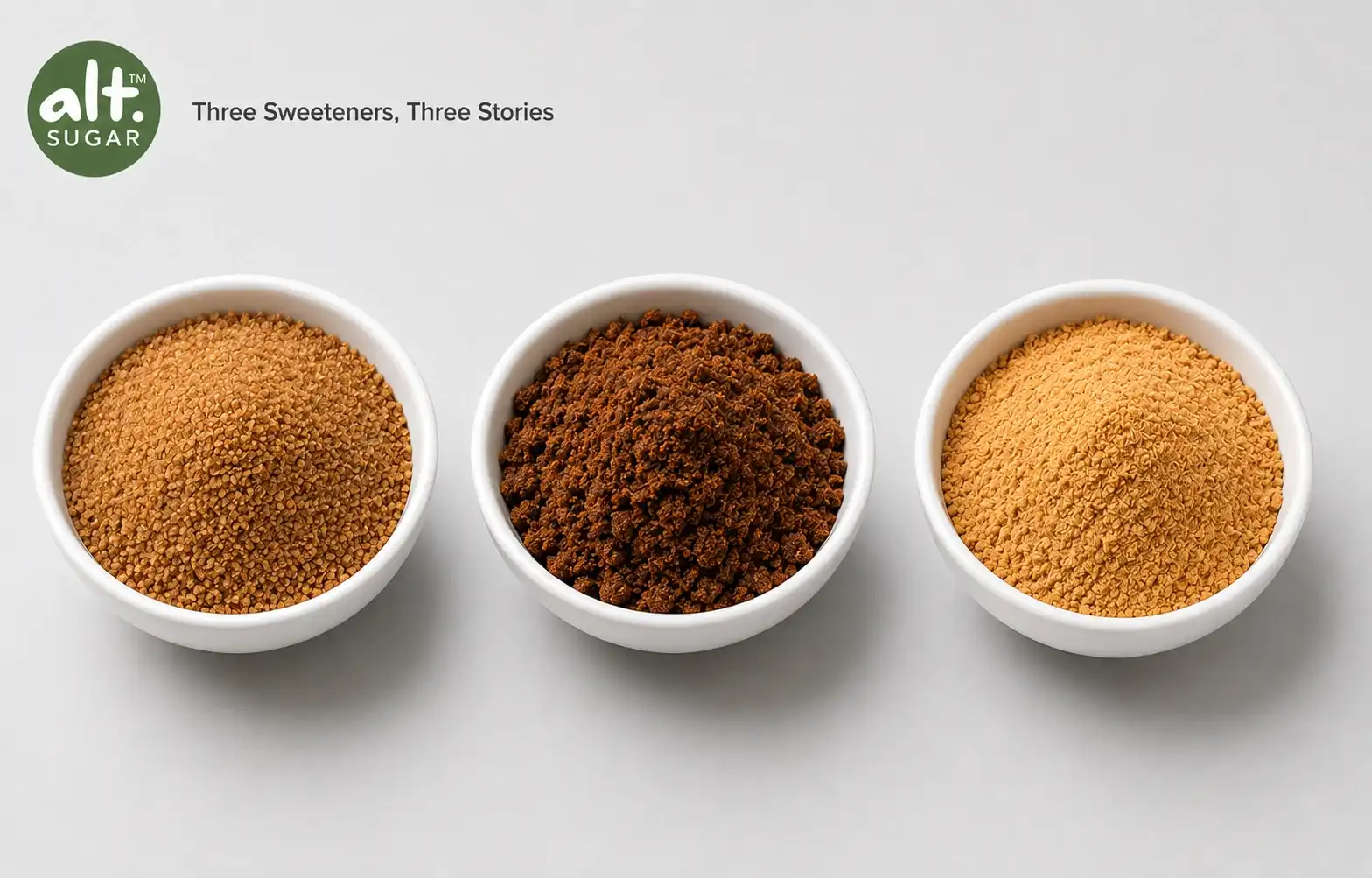
Three sweeteners. Three completely different stories. Three very different answers to the question of what belongs in your product or your kitchen.
And yet the conversation I hear most often, from food founders, R&D directors, product developers, and health-conscious consumers alike, treats these three as essentially the same thing natural alternatives to refined sugar, broadly interchangeable, choose whichever is cheapest or most available.
That misunderstanding is costing food brands poor formulation decisions, unnecessary reformulation cycles, and missed label opportunities. It is costing consumers products that do not perform the way they expected.
This blog fixes that.
Why This Comparison Matters More Than Most People Realise
Here is something the natural sweetener industry does not say clearly enough.
Choosing the wrong natural sweetener for your application does not just affect taste. It affects texture. It affects shelf life. It affects how the product behaves during processing. It affects the glycemic response of the person consuming it. It affects what your label says and what your consumer believes about your product.
A jaggery-sweetened product, a date-sweetened product, and a coconut-sugar-sweetened product are not three versions of the same thing. They are three genuinely different products with different nutritional profiles, different flavour architectures, different functional behaviours in formulation, and different stories to tell on a label.
Understanding which one belongs in your formulation and why is not a minor detail. It is a foundational ingredient decision that shapes everything that follows.
Let us go through each one properly.
Coconut Sugar The Balanced Everyday Sweetener
What it actually is
Coconut Sugar is made from the nectar of coconut palm blossoms not from the coconut fruit itself, which surprises many people. The flower blossom is tapped, the sap collected, and the liquid gently heated until the water evaporates, leaving behind granules of coconut sugar with a flavour profile that sits somewhere between light caramel and mild toffee.
It is minimally processed. It is traceable to a specific agricultural source. And it has been used across Southeast Asia for centuries in ways that refined sugar simply has not.
What the nutrition actually looks like
Coconut Sugar has a glycemic index of approximately 35 meaningfully lower than refined white sugar at 65, and lower than jaggery at approximately 70. It contains trace amounts of potassium, zinc, iron, and short-chain fatty acids. It also contains small amounts of inulin a naturally occurring prebiotic fiber that is thought to contribute to its lower glycemic response by slowing glucose absorption.
To be clear: coconut sugar is still sugar. It should not be consumed without thought or positioned as a health food without qualification. But in the context of natural sweetener comparison, its lower GI and its mineral trace content make it genuinely different not just differently named from refined white sugar.
Where it performs best
Coconut Sugar behaves very closely to refined white or brown sugar in most applications. It dissolves well in both dry and liquid formats. Its flavour is mild enough not to dominate other ingredients. And it replaces refined sugar at approximately a 1:1 ratio in most recipes and formulations which makes reformulation considerably simpler than with some other natural sweeteners.
For food brands: hot beverages coffee, tea, specialty lattes. Confectionery and chocolates where a clean, mild caramel note enhances rather than dominates. Premium sauces and dressings. Healthy snacking products where clean-label positioning needs to be visible but flavour impact needs to remain subtle. Breakfast cereals and granola where a gentle sweetness is preferred.
For home cooks: use it anywhere you would use caster sugar or light brown sugar. Coffee. Baking. Desserts. Anywhere the mild caramel note works with your dish rather than against it.
The label story
Sweetened with Coconut Sugar is a clean, recognisable, globally understood clean-label claim. It has strong consumer recognition across Western markets, the Middle East, and Southeast Asia. It photographs well. It tells a simple story. And it carries the kind of heritage credibility that refined sugar will never have.
Jaggery The Honest Sweetener That Never Needed Rebranding
What it actually is
Jaggery is what you get when you take sugarcane juice or palm sap in some regions and concentrate it through boiling without the chemical refining process that strips refined sugar of everything except sucrose. The molasses remains. The minerals remain. The colour, the flavour, the complexity all of it remains.
It is, in the most literal sense, unrefined sugar. Not unrefined as a marketing term. Unrefined as an accurate description of what was and was not done to it.
Jaggery has been part of Indian food culture for longer than most people can document. It appears in Ayurvedic texts. It appears in harvest festivals. It appears in the daily kitchens of communities across India who never switched to refined white sugar because they never saw a reason to. They were right.
What the nutrition actually looks like
Jaggery has a glycemic index of approximately 70 higher than coconut sugar and date powder, and closer to refined sugar. This is important information for health-focused applications and for consumers managing blood sugar. Jaggery is not a low-GI sweetener.
What it does offer is a genuine mineral profile iron, magnesium, potassium, and phosphorus retained from the sugarcane juice. It is particularly notable for iron content, which is one reason traditional Ayurvedic practice recommends it specifically. It also retains small amounts of B vitamins.
The trade-off is honest: jaggery is closer to refined sugar in its glycemic behaviour than coconut sugar or date powder, but it is nutritionally richer than refined sugar in ways that are measurable and meaningful.
Where it performs best
Jaggery's defining characteristic beyond its nutrition is its flavour. It is bold. It is earthy. It has a deep, complex caramel quality that coconut sugar's subtlety cannot match and that refined sugar cannot replicate at all. That flavour is its greatest asset in the right application and its primary limitation in the wrong one.
For food brands: traditional Indian sweets and mithai where jaggery is the historically correct ingredient. Ayurveda-positioned and wellness-focused products where its traditional credentials are part of the brand story. Seasonal and functional beverages herbal teas, kadhas, immunity drinks where its bold character enhances the overall flavour architecture. Cultural and ethnic product formulations targeting diaspora communities and heritage food markets internationally.
For home cooks: traditional Indian desserts. Laddoos, chikkis, pongal, puran poli. Any recipe where jaggery's bold, earthy complexity is the point rather than the background. Do not use it where you want subtlety. Use it where you want character.
The label story
Sweetened with Jaggery or Jaggery Powder carries enormous credibility in the Indian market and growing credibility internationally as heritage positioning gains traction in clean-label food. The word itself jaggery has a provenance that refined sugar will never have. For brands building a story of tradition, authenticity, and Indian agricultural heritage, jaggery is a label asset of real value.
Date Powder The Whole-Fruit Sweetener That Changes What Sweetness Can Do
What it actually is
Date Powder is made from the whole date fruit dehydrated and ground into a fine powder. Nothing is removed. Nothing is added. Every compound present in the original fruit the fiber, the minerals, the antioxidants, the natural sugars, the flavour complexity is present in the powder.
This is what makes Date Powder categorically different from both coconut sugar and jaggery, and from every other natural sweetener in this comparison. It is not a sweetener made from a plant. It is the plant itself, in powdered form. The whole food, made usable.
I have spent the last six years building a company around this ingredient because I believe it represents something the food industry has been looking for without fully realising what to look for. A sweetener that genuinely nourishes. A single ingredient that is also a functional food. A product that makes the food it is in better not just sweeter.
What the nutrition actually looks like
Date Powder has a glycemic index of approximately 42 lower than refined sugar, lower than jaggery, and competitive with coconut sugar. The reason is the fiber. Dates are a fiber-rich fruit, and that fiber is retained in the powder. It physically slows glucose absorption which is not a marketing claim but a basic nutritional mechanism. The sweetener contains its own moderation.
Beyond the GI, every gram of Date Powder carries potassium, magnesium, iron, copper, B vitamins, and a range of antioxidant compounds including flavonoids and carotenoids. The nutritional profile is, by a meaningful margin, the richest of the three sweeteners in this comparison.
The flavour is a warm, complex caramel deeper than coconut sugar, more rounded than jaggery, with a natural sweetness that most people describe as the most pleasant of the three when tasted blind.
Where it performs best
Date Powder's primary limitation is solubility. Because it retains the fiber of the whole fruit, it does not dissolve fully in water the way refined sugar or coconut sugar does. This is not a defect it is a property. In the right applications it is an asset. In the wrong applications it requires format adjustment.
In dry, baked, and structured applications Date Powder is outstanding. Cookies, cakes, muffins, energy bars, granola, breakfast cereals, protein bars, dry spice blends. It integrates seamlessly and adds flavour depth that refined sugar cannot touch.
In liquid applications use Date Syrup instead. The syrup format delivers the same nutritional profile and flavour character in a fully liquid-miscible form, ideal for beverages, sauces, marinades, dressings, and dairy applications.
In filling and structural applications Date Paste provides sweetness, texture, and moisture retention for bakery fillings, confectionery centres, and baby food applications.
For food brands: this is the most versatile and nutritionally powerful of the three sweeteners across the widest range of modern food categories. Bakery and confectionery. Baby foods and infant nutrition. Nutraceuticals and functional foods. Premium beverages via syrup format. HoReCa applications. White-label manufacturing for health-positioned brands.
For home cooks: baked goods, energy balls, smoothies via date syrup, porridge, overnight oats. Any application where a rich, natural sweetness and genuine nutrition is the goal.
The label story
Sweetened with Date Powder or contains Date Sugar is one of the most powerful clean-label claims available in the natural sweetener space today. One ingredient. The whole fruit. No chemistry required to explain it. And a growing body of consumer awareness particularly in Western markets, the Middle East, and among health-conscious urban consumers in India that makes date a positive label signal rather than an unfamiliar one.
The Side-By-Side Truth
Here is the comparison that most natural sweetener content carefully avoids because being specific means being accountable.
The Decision Framework Which One Is Actually Right for You
After six years of working with food brands on exactly this question, here is the framework I use in every conversation.
Choose Coconut Sugar when: Your priority is the simplest possible reformulation a near 1:1 substitute for refined sugar with minimal flavour impact and maximum application compatibility. You are working with beverages, premium sauces, or snacking products where subtlety is a virtue. Your target consumer is globally minded and already familiar with coconut sugar as a clean-label claim.
Choose Jaggery when: Your product has a traditional, heritage, or Ayurvedic positioning that the ingredient itself needs to reinforce. You are formulating for markets where jaggery is a familiar and trusted ingredient India, South Asia, diaspora communities internationally. You want a bold flavour that contributes character to your product rather than sitting quietly in the background. You are building seasonal, wellness, or functional beverage formulations.
Choose Date Powder when: Nutritional density is a priority you want a sweetener that genuinely contributes to the product's health credentials, not just its label. You are working in bakery, confectionery, energy products, baby foods, or nutraceuticals where the full-fruit fiber and mineral profile adds real value. Your target consumer is health-literate and reads ingredient lists. You want the most compelling single-ingredient label story available in the natural sweetener category.
Consider blending when: The brief is complex enough that no single sweetener solves all of it. A Date Powder and Coconut Sugar blend gives you nutritional density with broader application compatibility. A Jaggery and Date Powder blend gives you bold flavour with improved nutritional profile. The blend is often where the most interesting formulations happen and where the label story becomes genuinely distinctive.
A Note From the Farm
I want to say something that goes beyond formulation guidance.
Each of these three sweeteners represents a farming community. Coconut palm farmers across coastal India and Southeast Asia. Sugarcane farmers producing jaggery through generations of knowledge that no textbook captures. Date farmers in Rajasthan and Gujarat people I have visited, whose post-harvest challenges I understand, whose income is directly affected by whether the food industry chooses to use their crop or import from elsewhere.

When a food brand chooses a natural sweetener over refined sugar, they are not just making a formulation decision. They are participating in a supply chain that either supports these farming communities or does not.
At AltSugar™ we supply all three Coconut Sugar, Jaggery Powder, and Date Powder in all formats alongside our full portfolio of natural sweetening ingredients. We source with the understanding of where these ingredients come from and what they represent beyond their nutrition panel. And we work with food brands who want to make ingredient decisions they can genuinely stand behind.
That matters. And I believe it will increasingly matter to the consumers reading the labels of your products.
The Takeaway Stop Choosing Blind
Coconut Sugar, Jaggery, and Date Powder are not three names for the same thing. They are three distinct ingredients with different nutritional profiles, different flavour architectures, different functional behaviours, and different stories to tell on a label.
Choosing between them without understanding those differences is not a neutral decision. It is a decision made with incomplete information and in formulation, incomplete information produces predictable outcomes.
The map is now in your hands. Use it.
Share this article

About the Author
Sachhin Kummar
Founder, AltSugar™
Sachhin Kummar is the Founder of AltSugar™, an ingredient company dedicated to helping food manufacturers, FMCG brands, and food innovators reduce refined and synthetic sugar through natural, clean-label sweetening solutions. With 6+ years working specifically with R&D teams, procurement functions, and product development leaders on the natural sweetener transition.
Connect on LinkedIn