In the last six years I have had the same conversation more times than I can count.
A food founder smart, passionate, genuinely committed to building something better sits across from me and describes a problem. They launched a product. The sweetener they chose made sense at the time. The price was right. The certification box was ticked. The brief was technically satisfied.
And then something went wrong.
Sometimes it was the taste an aftertaste nobody noticed in the lab but every consumer noticed in the first bite. Sometimes it was the texture a product that looked right in the development kitchen but behaved differently at production scale. Sometimes it was the label a sweetener that cleared internal approval but created confusion with the retailer or the consumer the brand was trying to reach. Sometimes it was the cost an ingredient that was affordable at 50 kilograms but unsustainable at 500.


In almost every case, the problem traced back to the same root cause.
The sweetener was chosen for the wrong reasons.
Not bad reasons. Not irresponsible reasons. Wrong reasons reasons that made sense in isolation but did not account for everything the sweetener needed to do in the real world of a real food product reaching real consumers.
This blog is the conversation I wish every food founder had before they made that decision not after.
Why the Sweetener Decision Is More Consequential Than Most Founders Realise
The sweetener in a food product does not just sweeten. That is the misunderstanding that sits at the root of most reformulation problems.
Sugar refined white sugar, the ingredient that most natural sweeteners are being asked to replace does at least six things in a typical food formulation simultaneously. It sweetens. It provides bulk and body. It contributes to texture and mouthfeel. It affects moisture retention and shelf life. It influences browning and caramelisation in baked applications. And it balances and rounds out other flavours in a way that is easy to take for granted until it is gone.

When you replace refined sugar with a natural sweetener, you are not making a single ingredient swap. You are asking a new ingredient or a system of ingredients to replicate some or all of those six functions, while also delivering on clean-label credentials, nutritional improvements, consumer taste acceptance, regulatory compliance across your target markets, and supply reliability at your production scale.
That is a significant brief. And it is a brief that price per kilogram alone cannot evaluate.
The food founders who get this right who choose their sweetener in a way that holds up through product development, scale-up, retail listing, and consumer feedback are the ones who start the decision process with a framework rather than a price list.
Here is that framework.
The Four Questions to Answer Before You Look at a Single Sweetener
Question One: What is your product actually asking the sweetener to do?
This sounds obvious. It is not. Most sweetener briefs I see describe the outcome we want a clean-label, low-GI, natural sweetener without describing the function. Does your product need the sweetener to dissolve fully in a liquid? Does it need to brown in a hot oven? Does it need to provide structural bulk in a bar or bite? Does it need to remain stable across a twelve-month shelf life in a humid climate?
Each of these functional requirements points toward specific sweetener solutions and away from others. Date Powder is outstanding in baked goods and dry blends but does not fully dissolve in water for liquid applications you need Date Syrup. Monk Fruit Extract delivers intense sweetness at very low usage levels but provides no bulk in applications where sugar's volume contribution matters, it needs a partner ingredient. Erythritol provides bulk and a sugar-like usage level but crystallises in certain high-moisture applications.
The functional brief comes first. Everything else follows.
Question Two: Who is your consumer and what does your label need to say to reach them?
This is the question that most product development processes address last. It should be addressed second.
Your target consumer's relationship with sweetener names on a label is a purchasing criterion, not a detail. A parent buying infant nutrition reads Date Paste or Date Powder and feels reassurance a single whole-food ingredient they can visualise and trust. The same parent reads erythritol and reaches for their phone to check what it is. Both ingredients may be entirely appropriate nutritionally. Only one of them does the label job your brand needs.
Similarly a brand targeting the keto and low-carb community needs a sweetener that supports a zero-sugar or very-low-sugar nutritional claim. Monk Fruit Extract or Stevia Reb-M are the correct tools. Date Powder nutritionally superior in many ways does not support a zero-sugar claim because it contains natural fruit sugars. The ingredient that is right for one positioning is wrong for another, regardless of its absolute nutritional quality.
Know your consumer. Know your label story. Then choose your sweetener.
Question Three: What are the regulatory requirements of every market you intend to sell in?
This is the question that catches the most founders off guard particularly those building products with international ambitions from day one.
Natural sweetener regulatory status varies meaningfully across markets. An ingredient approved for use in India may have a different regulatory status in the European Union, the United States, or Gulf Cooperation Council markets. High-intensity sweeteners like Monk Fruit Extract and Stevia carry specific approval requirements in certain jurisdictions. Maximum usage levels for some sweeteners differ by product category and by market.
Getting this wrong does not just create a reformulation problem. It can create a market access problem a product that cannot be legally sold in the market you built it for, at the scale you planned to reach it.
The regulatory mapping conversation should happen at the ingredient selection stage before formulation investment is made, not after.
Question Four: What does your supply chain look like at three times your current volume?
Every food startup I have ever met is optimistic about growth. That optimism is correct it is the mindset that builds companies. But sweetener sourcing decisions made for current production volumes can become problems at scale.
A sweetener that is available at sample quantities and small batches is not automatically available in bulk at a consistent quality. Premium grades of Monk Fruit Extract particularly MV-25% and MV-50% have global supply constraints that tighten as demand grows. Freeze-dried fruit powders have seasonal availability considerations. Even Date Powder, sourced from Indian farms, has harvest cycle implications that a scaling brand needs to understand and plan for.
The supply chain question at the ingredient selection stage is not pessimistic. It is the thinking that protects the growth you are planning for.
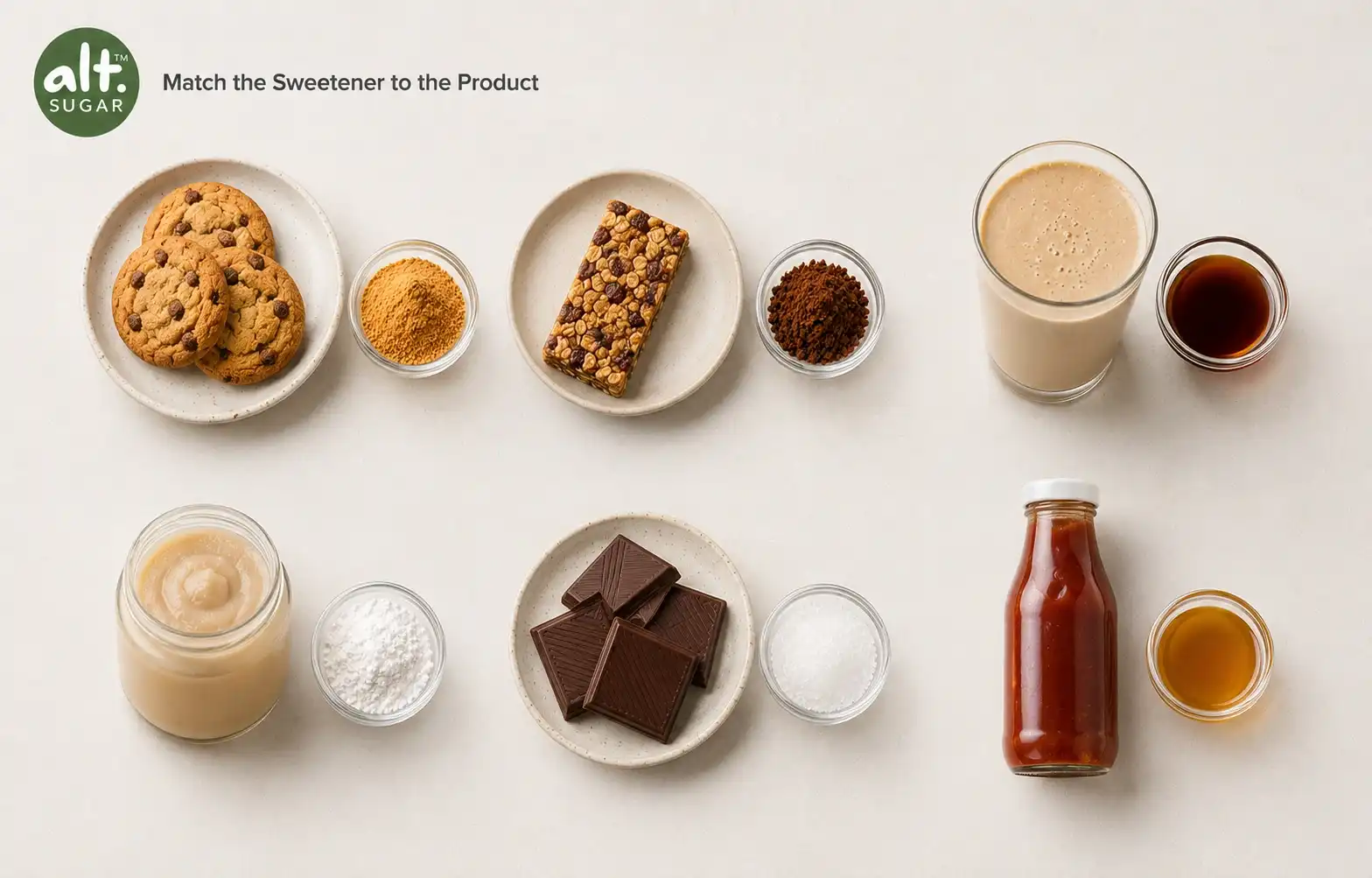
The Sweetener Decision Matrix Matched to Product Category
This is the framework I use when working with food brands at the formulation stage. It is not a rigid prescription formulation is always specific to the exact product, the exact brief, and the exact target market. But it is a reliable starting point that eliminates the most common wrong turns.
Bakery Cookies, Cakes, Muffins, Brownies, Bread
Primary recommendation: Date Powder.
Integrates seamlessly into dry mixes. Adds flavour complexity a warm caramel depth that refined sugar cannot replicate. Retains fiber and minerals. Labels cleanly as a single whole-food ingredient. Performs at 1:1 replacement in most baked applications.
Consider adding Coconut Sugar for a milder flavour profile, or Monk Fruit at low levels for calorie reduction without label complexity. Watch for slight additional moisture from Date Powder minor recipe adjustment usually required.
Energy Bars and Protein Snacks
Primary recommendation: Date Powder or Date Paste.
Both provide sweetness, binding, and genuine nutritional density in a format that the health-conscious consumer who buys these products actively looks for. Contains Date on an energy bar label is a positive claim. Fiber and mineral content supports the functional positioning.
Consider adding Monk Fruit at low levels to reduce overall sugar contribution while maintaining sweetness. Note that Date Paste adds significant moisture and binding adjust dry ingredient ratios accordingly.
Beverages Cold Pressed, Smoothies, Flavoured Waters, Lattes
Primary recommendation: Date Syrup.
The syrup format delivers Date's full nutritional and flavour profile in a fully liquid-miscible form. For premium beverage brands, sweetened with Date Syrup is one of the strongest clean-label claims available. Dissolves completely. Flavour is rich and natural.
Consider adding Monk Fruit Extract at very low levels to boost sweetness intensity without increasing sugar content. Note that Date Syrup has a distinctive flavour conduct taste trials before committing to ensure the profile works with your specific beverage formulation.
Baby Foods and Infant Nutrition
Primary recommendation: Date Paste or Date Powder.
This is the category where ingredient quality is most scrutinised and most consequential. Parents are the most label-literate consumer group in existence. A single whole-food sweetener with a gentle glycemic profile, genuine nutritional content, and a name that requires no explanation is not a premium option in this category it is the correct standard.
Keep the ingredient list as simple as possible. Regulatory requirements for sweeteners in infant nutrition vary by market and by age category verify compliance before finalising formulation.
Nutraceuticals and Functional Foods
Primary recommendation: Date Powder for nutrition-forward products. Monk Fruit Extract or Stevia Reb-M for zero-calorie or diabetic-focused products.
The sweetener choice in nutraceuticals must align precisely with the health claim the product is built around. A blood sugar management product cannot be sweetened with an ingredient that raises blood sugar. A weight management product needs a sweetener that supports its caloric positioning. The functional claim and the sweetener must be consistent.
Consider a custom blend Date Powder with Monk Fruit for a sweetener that delivers nutrition and low caloric impact simultaneously. Ensure your sweetener choice supports rather than undermines your intended health claim.
Confectionery Chocolates, Candies, Gummies, Chews
Primary recommendation: Coconut Sugar for traditional confectionery reformulation. Date Paste for premium-filled confectionery. Monk Fruit with erythritol for sugar-free positioning.
Confectionery is the most technically demanding category for natural sweetener reformulation texture, shelf life, processing behaviour, and consumer taste expectations are all tightly constrained. The right choice depends heavily on the specific confectionery format.
Consider Stevia Reb-M at low levels to reduce sugar content while maintaining sweetness. Erythritol for bulk in sugar-free formats. Every confectionery application requires specific testing do not skip application trials in this category.
Sauces, Dressings and Condiments
Primary recommendation: Date Syrup or Coconut Sugar.
Both dissolve well in liquid applications and add sweetness without dominating the savoury flavour profile most sauces are built around. Date Syrup adds body and a mild richness. Coconut Sugar dissolves cleanly and adds subtlety.
Consider Jaggery Powder for products with a specifically bold, traditional flavour profile. Note that sugar contributes to preservation in some sauce formulations consult with your food technologist if significant sugar reduction is planned.
HoReCa Hotel, Restaurant and Catering Applications
Primary recommendation: Date Syrup for liquid and drizzle applications. Date Powder for dry and baking applications. Coconut Sugar as a refined sugar table replacement.
Premium hospitality operators want ingredients that tell a story to their guests provenance, naturalness, quality. All three of these sweeteners support that positioning while delivering genuine culinary performance.
Consider Jaggery Powder for specifically Indian or heritage-positioned menu items.
The Mistake That Costs the Most And How to Avoid It
Of all the sweetener mistakes I have observed in food brand development, one is more expensive than all the others combined.
Testing the sweetener in isolation.
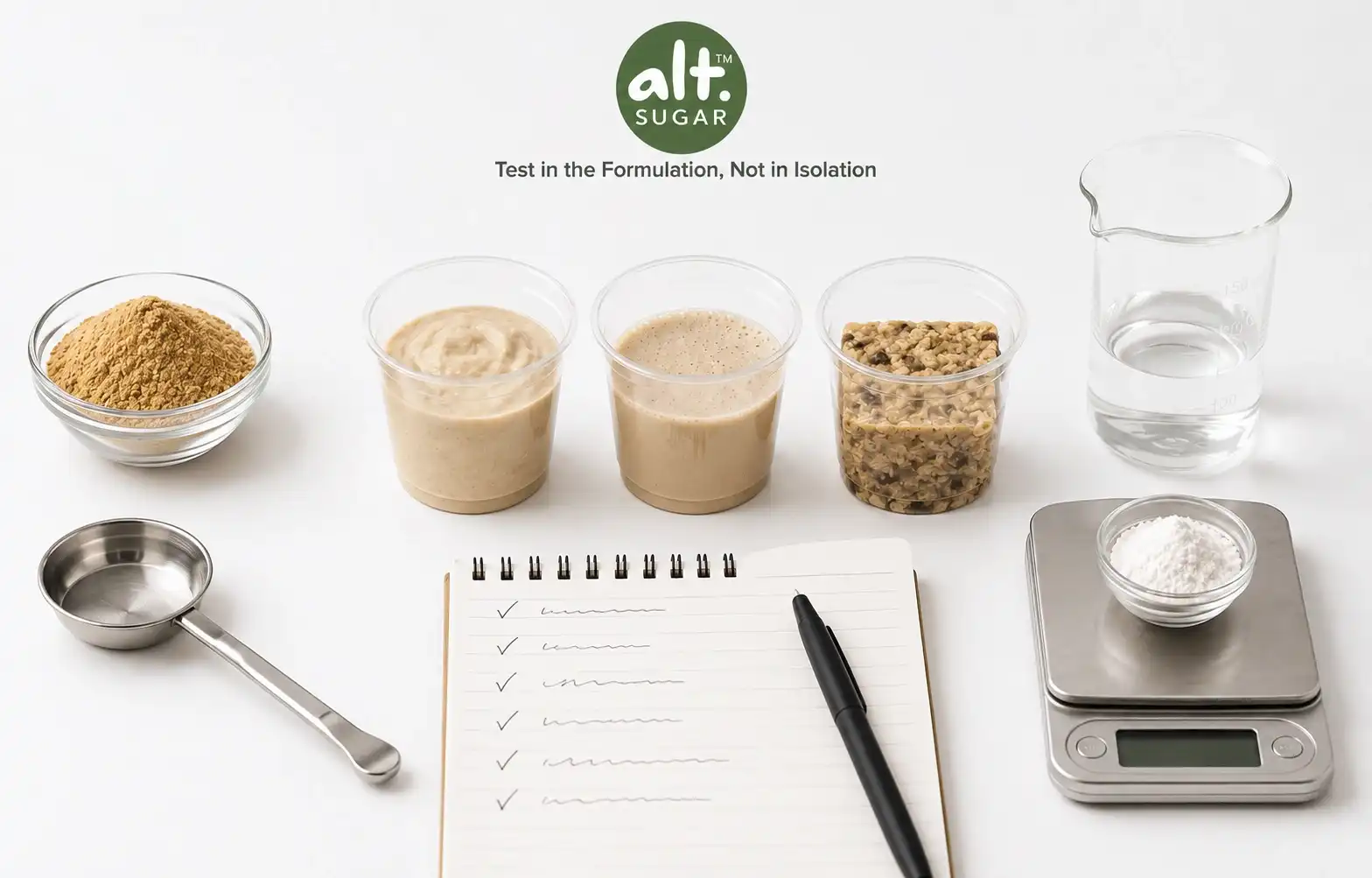
A sweetener that performs perfectly in a glass of water does not automatically perform perfectly in your product. The interaction between your sweetener and every other ingredient in your formulation the proteins, the fats, the acids, the gums, the starches, the heat it experiences during processing determines the real-world performance.
Monk Fruit Extract tested alone tastes clean and simple. Monk Fruit Extract tested in a high-acid beverage with citric acid may behave differently. Date Powder tested alone has a straightforward flavour. Date Powder tested in a formulation with significant fat content may interact with the fat in ways that affect both texture and flavour release.
Test your sweetener in your formulation matrix. At your processing temperature. At your production scale. At the end of your intended shelf life, not just on day one.
The cost of thorough application testing is a fraction of the cost of a product recall, a retailer rejection, or a reformulation after launch.
At AltSugar™ we provide sample quantities of every ingredient specifically for application testing and our team works with your R&D function through the trial process, not just the sourcing process. That distinction matters more than most buyers realise until they have experienced the alternative.
A Note on Building for the Long Term
I want to say something to every food founder reading this that goes beyond the formulation brief.
The sweetener you choose today will be on your label for years. It will be in the product your consumers recommend to their friends. It will be in the product a retailer buyer evaluates when deciding whether to expand your range. It will be in the product a journalist or nutritionist picks up and writes about.
Choosing it well choosing it with full understanding of what it needs to do, what it says on a label, where it comes from, and how it behaves at scale is one of the most important early decisions a food brand makes.
The brands that get this right from the beginning do not just avoid problems. They build an ingredient story that becomes a competitive asset something that genuinely differentiates their product in a market where most competitors are still looking for the cheapest way to tick the clean-label box.
That is the difference between a sweetener choice and a brand choice.
Make the brand choice.
Share this article

About the Author
Sachhin Kummar
Founder, AltSugar™
Sachhin Kummar is the Founder of AltSugar™, an ingredient company dedicated to helping food manufacturers, FMCG brands, and food innovators reduce refined and synthetic sugar through natural, clean-label sweetening solutions. With 6+ years working specifically with R&D teams, procurement functions, and product development leaders on the natural sweetener transition.
Connect on LinkedIn