
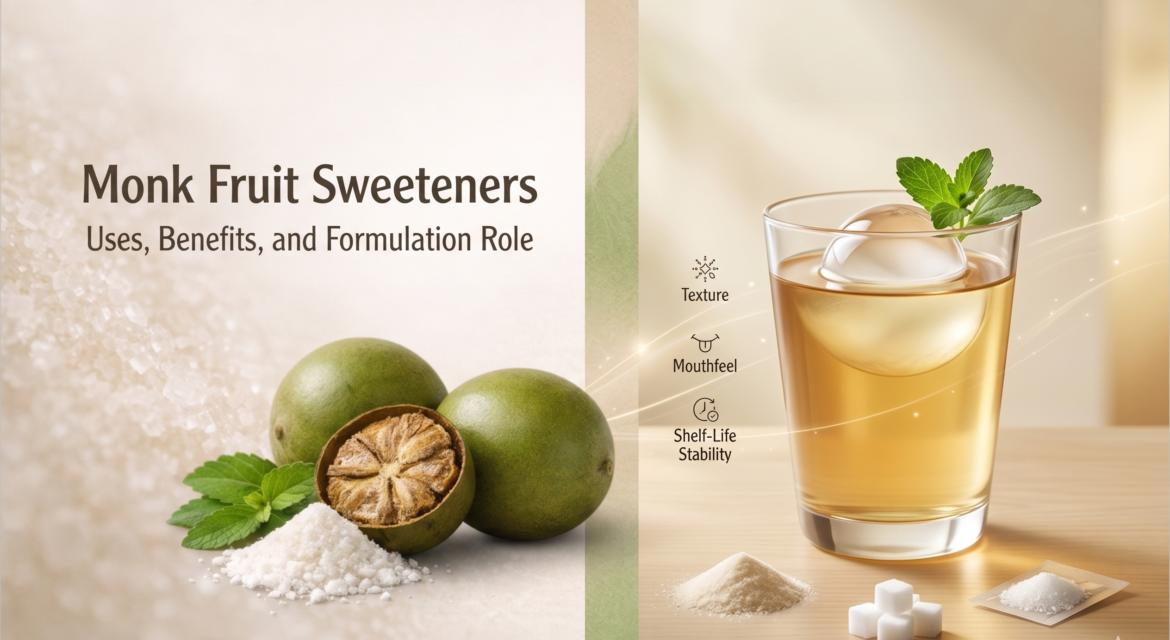
Learn how monk fruit sweeteners work, why erythritol is often used for 1:1 sugar-like systems, and where monk fruit fits in clean-label food and beverage reformulation.
Monk fruit has moved from a niche natural sweetener to a serious ingredient option for brands looking to reduce sugar without losing label appeal. For food and beverage manufacturers, product developers, R&D teams, procurement teams, brand owners, health-focused startups, nutraceutical companies, and bakery, beverage, dairy, confectionery, and functional food businesses, monk fruit is best understood not as a standalone sugar replacement, but as part of a broader sweetness system.
Its value lies in its high sweetness intensity, clean-label positioning, and ability to support reduced-sugar reformulation when used correctly. In most real-world applications, monk fruit is paired with a bulking sweetener such as erythritol to create a more sugar-like system in terms of sweetness, texture, and usage level
A fruit with a long cultural history
Monk fruit, known in China as Luo Han Guo, has been cultivated for centuries in the mountainous regions of southern China. The fruit is closely associated with Buddhist monks, who are believed to have been among the early cultivators and users of the fruit in traditional settings. Over time, it became part of a larger story about natural sweetness, traditional use, and regional food culture. Today, monk fruit is valued not for folklore alone, but for its role as a high-intensity natural sweetener in modern reformulation.
What monk fruit is…
Monk fruit is a natural sweetener derived from the fruit of Siraitia grosvenorii. The sweet taste comes from compounds called mogrosides, especially Mogroside V. Different extract grades deliver different sweetness intensities, which makes monk fruit useful across a wide range of formulations.
In practical terms, monk fruit extract is available in multiple potency levels. Lower-grade extracts may deliver around 20x the sweetness of sugar, while higher grades may reach 60x, 100x, or even 200x sweetness depending on mogroside content and extract standardization. That wide range makes it useful for developers who need flexibility in formulation design.
Why brands are interested in monk fruit
Interest in monk fruit has grown because it fits several current market priorities at once:
- It supports sugar reduction.
- It aligns with natural and clean-label positioning.
- It can be used in modern product development without immediately signalling “artificial sweetener” to consumers.
- It works well in ingredient systems where sweetness needs to be controlled carefully.
For brands, monk fruit is especially attractive where the goal is not only to reduce sugar, but also to protect the product’s premium or health-focused positioning. That matters in beverages, nutraceuticals, dairy, and better-for-you snacks, where the ingredient story is part of the product value proposition.
Monk fruit grades and sweetness levels
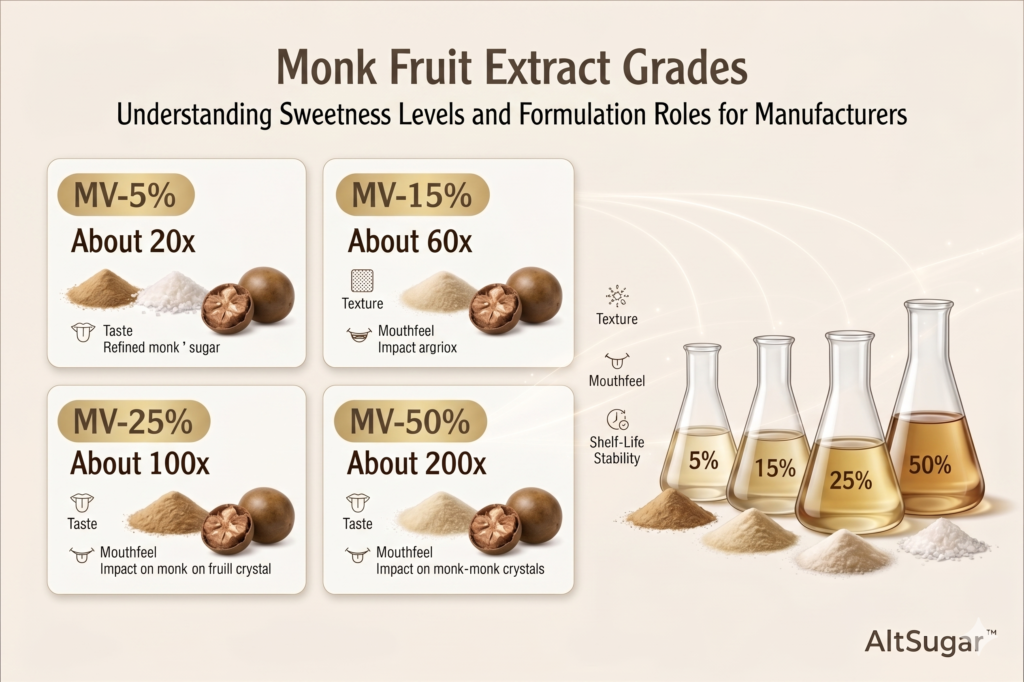
One of the most useful ways to think about monk fruit is by grade. Different mogroside-V percentages change the sweetness profile and how the ingredient behaves in use.
A simplified view looks like this:
| Monk fruit grade | Mogroside-V level | Approximate sweetness vs sugar | Typical use |
|---|---|---|---|
| MV-5% | Lower potency | About 20x sweeter | Broad sweetening support |
| MV-15% | Medium potency | About 60x sweeter | Reduced-sugar systems |
| MV-25% | Higher potency | About 100x sweeter | Strong sugar reduction |
| MV-50% | Very high potency | About 200x sweeter | High-intensity systems |
Why monk fruit is often blended with erythritol
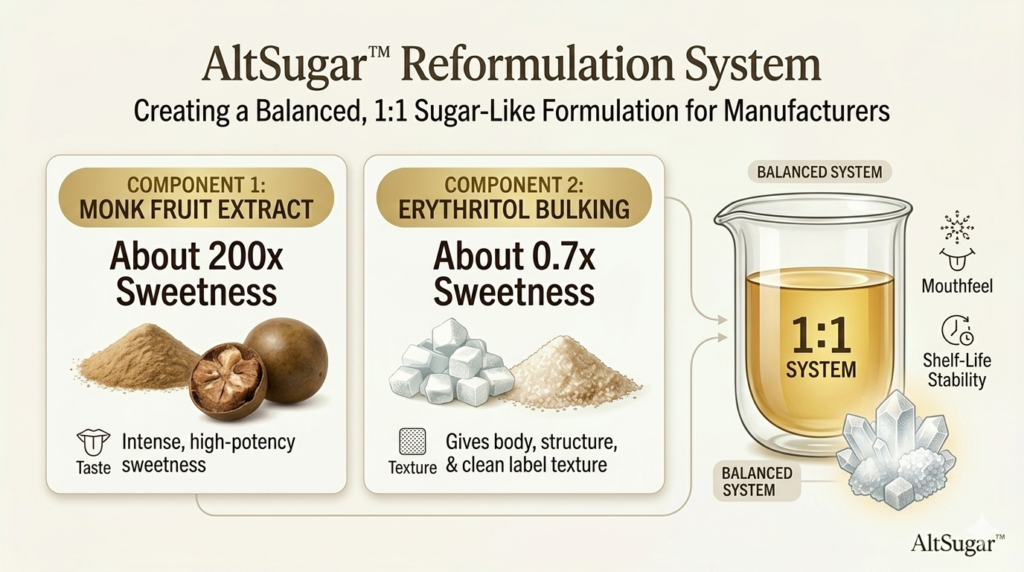
A common misunderstanding is that monk fruit can be used exactly like sugar. In reality, monk fruit is a high-intensity sweetener, which means it delivers sweetness at very low usage levels but does not provide the bulk, mouthfeel, or functional mass that sugar contributes.
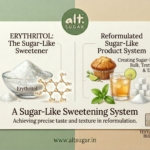
That is why erythritol is often used as the base in a 1:1 sugar-like system. Erythritol helps provide:
- Volume.
- Better handling in formulation.
- A more sugar-like usage pattern.
- Improved sensory balance when combined with monk fruit.
When monk fruit and erythritol are used together, the result is typically a more practical sweetening system than monk fruit alone. The monk fruit contributes the sweetness intensity, while erythritol contributes the body and use-level structure needed for product development.
This system is especially useful for brands that want a 1:1 style replacement in retail-facing products, where consumers expect an easy switch from sugar to alternative sweetening.
Key formulation benefits
For product developers and R&D teams, monk fruit offers several advantages when properly formulated:
- It supports sweetness without requiring large ingredient additions.
- It helps reduce sugar content in a clean-label framework.
- It can be used in blends to improve taste balance.
- It fits well with natural product positioning.
- It can support premium or health-oriented brand stories.
It is also useful to remember that monk fruit is rarely a one-ingredient solution. In practice, it is most effective when paired with ingredients that provide bulk, texture, or taste correction. That is where formulation skill matters most.
Where monk fruit works best
Monk fruit can be used across a range of categories, but it is particularly relevant in:
- Beverages.
- Dairy and fermented products.
- Confectionery.
- Bakery items.
- Nutritional powders and sachets.
- Functional foods.
- Health-focused product launches.
In beverages, monk fruit can help reduce sugar while maintaining a more natural sweet profile. In dairy, it may support better sweetness in yogurts or flavoured milk systems. In bakery and confectionery, it is often used as part of a broader sweetness system rather than as a direct one-to-one sugar swap.
What procurement teams should evaluate
For procurement teams, monk fruit is not just a sweetener choice — it is a sourcing and consistency decision. Important considerations include:
- Mogroside-V content.
- Sweetness intensity.
- Powder colour and appearance.
- Batch-to-batch consistency.
- Minimum order quantity.
- Commercial fit for the target application.
The uploaded sheet shows how monk fruit grades can vary by sweetness level and extract profile, which is useful for comparing options during sourcing discussions. In procurement terms, the key question is not only “what is the price?” but also “what performance does this grade deliver in the final application?
How to think about monk fruit in product development
The best monk fruit formulations start with the end product in mind. A beverage, a bakery item, and a powdered nutraceutical blend all need different sweetness balance, sensory profile, and processing tolerance.
That means the development process should consider:
- Desired sugar reduction level.
- Sweetness curve and aftertaste.
- Need for bulk or mouthfeel.
- Compatibility with other ingredients.
- Labeling and positioning goals.
When those factors are planned well, monk fruit can be a highly effective part of a modern sweetening system. When they are ignored, the product may taste too sharp, too thin, or too different from the consumer’s expectation.
Final perspective
Monk fruit is best understood as a strategic sweetening ingredient for brands that want to move toward cleaner, more natural sugar reduction without compromising product positioning. Its real strength appears when it is used with the right base ingredients, the right grade, and the right formulation logic.
For brands exploring monk fruit, the most practical systems often combine monk fruit extract with erythritol to create a more sugar-like sweetness profile and a usable 1:1 style system.
For more information on Monk Fruit Extracts and its various grades, visit the AltSugar™ website: https://altsugar.in/
AltSugar™ is a thought, a team, a company, and a life dedicated to creating and working towards natural alternatives to sugar. We are not just building a business; we are driving a mission to reshape how the world consumes sweetness.