

Xylitol is one of the most widely recognized sweetening ingredients in the sugar-alternative category, especially where brands want sweetness, functionality, and a more familiar taste profile. For food and beverage manufacturers, product developers, R&D teams, procurement teams, brand owners, health-focused startups, nutraceutical companies, and confectionery businesses, xylitol is often valued for its close sweetness resemblance to sugar and its strong positioning in oral-care-related products.
Unlike highly potent sweeteners that must be used in very small amounts, xylitol behaves more like a bulk sweetener. That makes it useful in applications where taste, mouthfeel, and product structure matter. It is also commonly associated with products that support a cleaner ingredient story and a more functional sweetening approach.
What xylitol is
Xylitol is a sugar alcohol used as a sweetener in a wide range of food applications. It occurs naturally in small amounts in certain fruits and vegetables, but commercially it is typically produced for use in food and beverage formulations.
From a sensory perspective, xylitol is known for delivering sweetness that is close to sucrose, which is one reason it has become popular in confectionery, chewing gum, mints, and oral-care-focused products. It is also appreciated for its cooling sensation, which can be useful in certain applications.
Why xylitol is used
Brands often choose xylitol because it offers several practical advantages:
- It provides a sweetness profile that is relatively close to sugar.
- It contributes body and bulk better than many high-intensity sweeteners.
- It is useful in products where mouthfeel matters.
- It has a strong association with oral-care-friendly positioning.
- It works well in confectionery and similar applications where sugar-like taste is important.
For product teams, this makes xylitol a useful ingredient when the goal is not just to reduce sugar, but to keep the product experience familiar and functional.
Product positioning and consumer perception
One reason xylitol remains relevant is that consumers often understand it better than some newer sweeteners. It has been used for years in gum, mints, and oral-care products, so it already carries a degree of familiarity in the market.
That said, the way xylitol is positioned matters. In some cases, it is highlighted as a sugar alternative for taste and texture. In others, it is presented as part of a broader oral-care or functional product story. For brand owners, this flexibility can be helpful when building a product narrative.
Key functional benefits
Xylitol offers several formulation advantages:
Sweetness close to sugar
Its taste profile is one of the main reasons formulators use it. It can help reduce the sensory gap between sugar-containing and sugar-alternative products.
Bulk and mouthfeel
Because xylitol behaves more like a bulk ingredient than an intense sweetener, it can help support body and texture in the final product.
Cooling effect
Xylitol can create a cooling sensation, which is useful in mint-based, gum, and oral-care formulations.
Clean-label and functional appeal
Depending on the product and market, xylitol can support a more natural or functional positioning compared with some artificial sweeteners.
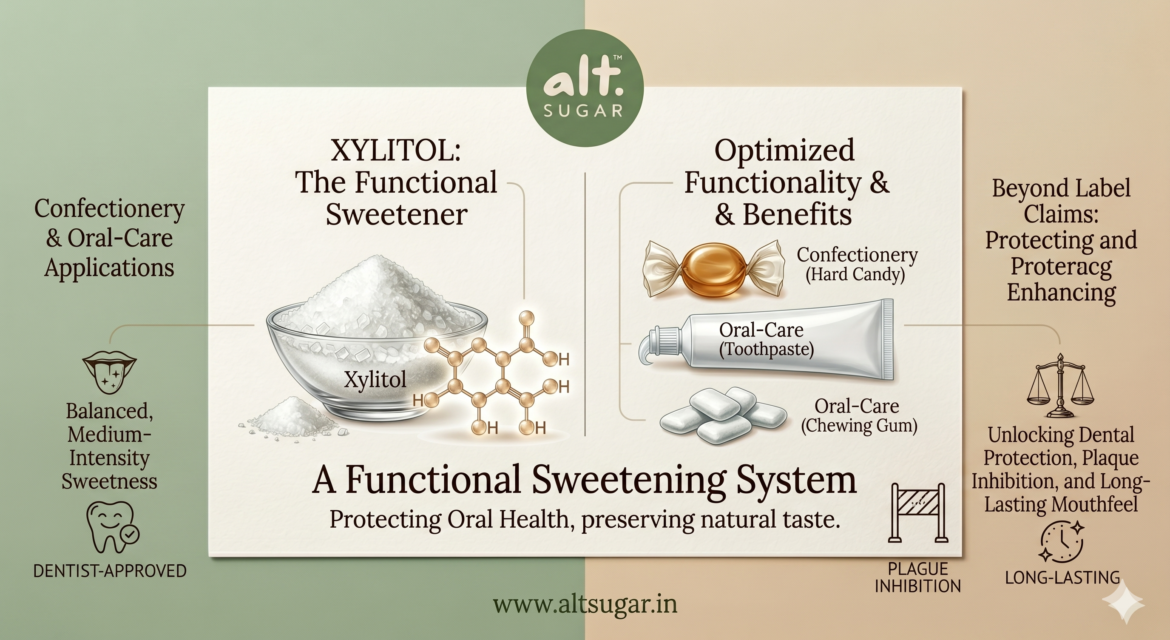
Where xylitol works best
Xylitol is especially suitable for:
Chewing gum
This is one of the best-known applications for xylitol, especially where taste and oral-care positioning matter.
Mints and candies
Its sweetness and cooling effect make it a strong fit for minty and confectionery products.
Oral-care products
It is often used in products associated with dental or oral-health positioning.
Functional confectionery
It can support better product texture and sweetness in better-for-you candy formats.
Some bakery and specialty applications
In specific formulations, xylitol may be used where a sugar-like sweetness profile and bulk are needed.
For product developers, the key is to match xylitol to the right application rather than trying to force it into every product category.
What R&D teams should consider
For formulators, xylitol should be evaluated based on the final product goal. Important questions include:
- Does the product need bulk or only sweetness?
- Is a cooling effect desirable or distracting?
- How will xylitol interact with other sweeteners?
- Does the application require oral-care positioning?
- What texture or structure needs to be maintained?
The best xylitol formulations usually start with the product experience, not just the ingredient itself.
What procurement teams should evaluate
For procurement teams, the key considerations are usually:
- consistency of supply.
- particle size or grade.
- application suitability.
- price-performance balance.
- final use category.
Since xylitol is used in different types of products, sourcing teams should align the grade and supply expectations with the intended application, not just the sweetener name.
Xylitol in modern sweetening systems
Although xylitol can work on its own, it is often used as part of a broader sweetening system. In some formulations, it may support other sweeteners by adding bulk, improving mouthfeel, or helping the product feel more sugar-like.
This is why xylitol remains relevant in modern reformulation work. It is not only a sweetener; it is also a functional ingredient that can help make reduced-sugar products more usable and more familiar to the consumer.
Final perspective
Xylitol holds a strong place in the sugar-alternative category because it bridges sweetness, function, and product familiarity. It is especially useful in confectionery, chewing gum, oral-care-related products, and other applications where a sugar-like experience matters.
For brands building modern clean-label or functional product lines, xylitol can be a practical ingredient when the goal is to preserve sensory quality while moving away from sugar.
For more information on Xylitol as natural sweetening systems and ingredient options, visit the AltSugar™ website: www.altsugar.in
AltSugar™ is a thought, a team, a company, and a life dedicated to creating and working towards natural alternatives to sugar. We are not just building a business; we are driving a mission to reshape how the world consumes sweetness.